


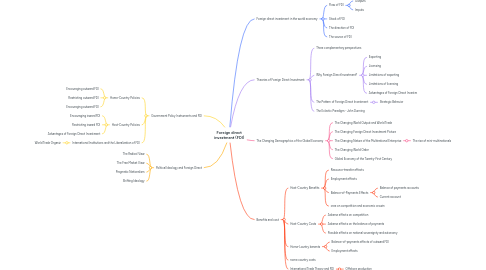
1. Government Policy Instruments and FDI
1.1. Home-Country Policies
1.1.1. Encouraging outward FDI
1.1.2. Restricting outward FDI
1.1.3. Encouraging outward FDI
1.2. Host-Country Policies
1.2.1. Encouraging inward FDI
1.2.2. Restricting inward FDI
1.2.3. Advantages of Foreign Direct Investment
1.3. International Institutions and the Liberalization of FDI
1.3.1. World Trade Organiz
2. Political Ideology and Foreign Direct
2.1. The Radical View
2.2. The Free Market View
2.3. Pragmatic Nationalism
2.4. Shifting Ideology
3. Foreign direct investment in the world economy
3.1. Flow of FDI
3.1.1. Outputs
3.1.2. Imputs
3.2. Stock of FDI
3.3. The direction of FDI
3.4. The source of FDI
4. Theories of Foreign Direct Investment
4.1. Three complementary perspectives
4.2. Why Foreign Direct Investment?
4.2.1. Exporting
4.2.2. Licensing
4.2.3. Limitations of exporting
4.2.4. Limitations of licensing
4.2.5. Advantages of Foreign Direct Investm
4.3. The Pattern of Foreign Direct Investment
4.3.1. Strategic Behavior
4.4. The Eclectic Paradigm - John Dunning
5. The Changing Demographics of the Global Economy
5.1. The Changing World Output and World Trade
5.2. The Changing Foreign Direct Investment Picture
5.3. The Changing Nature of the Multinational Enterprise
5.3.1. The rise of mini-multinationals
5.4. The Changing World Order
5.5. Global Economy of the Twenty-First Century
6. Benefits and cost
6.1. Host-Country Benefits
6.1.1. Resource-transfer effects
6.1.2. Employment effects
6.1.3. Balance-of-Payments Effects
6.1.3.1. Balance of payments accounts
6.1.3.2. Current account
6.1.4. cree on competition and economic crowin
6.2. Host-Country Costs
6.2.1. Adverse effects on competition
6.2.2. Adverse effects on the balance of payments
6.2.3. Possible effects on national sovereignty and autonomy
6.3. Home-Lountry benents
6.3.1. Balance-of-payments effects of outward FDI
6.3.2. Employment effects
6.4. nome country costs
6.5. International Trade Theory and FDI
6.5.1. Offshore production