


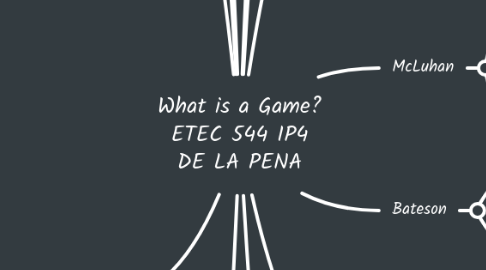
1. Sutton-Smith
1.1. We decide games
1.2. Games reflect evolution of society
1.3. games as finite, fixed, and goal oriented
1.4. different forms
1.4.1. Social
1.4.2. Solitary
1.4.3. Physical
1.4.4. Theoretical
1.5. Neitzsche
1.5.1. Danger and Diversion
1.6. Jung
1.6.1. Play with objects it loves
2. Mead
2.1. social activity and communication
2.2. "make believe"
2.3. one role at a time
2.4. games as social mirrors
2.4.1. learning to belong
2.4.2. learning different roles
2.4.3. learning rules
2.4.4. allowing personality to develop
3. Jenkins
3.1. New form of popular art
3.2. artists of the century: game designers
3.3. Seldes
3.3.1. Aesthtics of great art
3.4. Lively art
3.5. Jenkins vision
3.5.1. design and aesthetics are crucial
4. Formal Definitions
4.1. Partlett
4.1.1. an ends and a means
4.1.2. games always has a winner
4.2. Quests
4.2.1. allow for exploration than a fixed setting
4.3. Suits
4.3.1. game rules are inhibiting (hinders)
4.3.2. people seek out rigid and restrictive structures
4.3.3. Monopoly
4.3.3.1. amassing wealth and ruining opponents
4.3.3.2. a game of skill
4.4. Crawford
4.4.1. Four features
4.4.1.1. Representation
4.4.1.2. Interaction
4.4.1.3. Conflict
4.4.1.4. Safety
4.4.2. Salen and Zimmerman
4.4.2.1. games are systems
4.4.2.2. games have quantifiable outcomes
4.4.2.3. artificial conflict
4.4.2.4. Jesper Juul
4.5. Online role playing games
4.5.1. set personal goals
4.5.2. no one way to win
4.5.3. World of Warcraft
4.5.4. Grand Theft Auto
5. Pragmatic Definitions
5.1. Meier
5.1.1. a good game is a series of interesting choices
5.2. Action games
5.2.1. Super Mario Brothers
5.2.1.1. lack of choice
5.2.2. a focus on players reflexes
5.2.3. a focus on players coordination skills
5.3. Hunicke, LeBlanc, and Zubek
5.3.1. MDA
5.3.1.1. Mechanics
5.3.1.2. Dynamics
5.3.1.3. Aesthetics
5.3.1.3.1. Sensation
5.3.1.3.2. Fantasy
5.3.1.3.3. Narrative
5.3.1.3.4. Challenge
5.3.1.3.5. Fellowship
5.3.1.3.6. Discovery
5.3.1.3.7. Expression
5.3.1.3.8. Submission
5.3.1.4. MDA Limitations
5.3.1.4.1. Design over Gameplay
6. Wittgenstien
6.1. Luck vs Skill
6.2. Family Resemblances
6.2.1. Game A-B-C
7. Huizinga
7.1. The Magic Circle
7.2. Chess Rules as Magic Circle
7.3. Castranova
7.4. Real World Consequences
7.4.1. Time
7.4.2. Affects Mood
7.4.3. Communication for Media
7.4.4. Affects Behaviour
7.4.5. Affects the outside world
7.5. Malaby
7.6. Juul
7.6.1. The Three Frames
7.6.2. Differentiate games from nongames model
8. Caillois
8.1. Four Qualities of Play
8.1.1. Competition
8.1.2. Chance
8.1.3. Imitation
8.1.4. Vertigo
8.2. Classification of games
8.2.1. Paidia
8.2.2. Ludus
8.3. Sandbox activity
8.3.1. Unspoken rules
8.4. Video Games
8.4.1. Rules enforced by a computer
9. McLuhan
9.1. Reflection of Culture
9.2. Dramatic Models
9.2.1. release of tension
9.3. Underexplored idea
10. Bateson
10.1. meta-communication
10.2. Alternate Reality Games
10.2.1. No big interest
11. Issue of Genre
11.1. How to define a games genre
11.2. Wolf
11.2.1. Interactivity for defining
11.3. Aarseth
11.3.1. evaluated on a series of variables
11.3.2. Genres are arbitrary
11.4. Genre labels
11.4.1. need to be based on same criteron
12. Genre system
12.1. games criteria
12.2. Action Games
12.2.1. motor skill and hand-eye coordination
12.3. Adventure Games
12.3.1. requires deep thinking
12.3.2. requires great patience
12.4. Strategy Games
12.4.1. based on games of war
12.4.2. real-time strategy
12.4.3. close relation to action games
12.4.3.1. winning is based on balancing large numbers of interdependent variables
12.4.3.2. paying attention to other players choices and strategies
12.5. Process-Oriented Games
12.5.1. Made for entertainment purposes
12.5.2. Character explores
12.5.3. Character manipulates an ever-changing world
12.5.3.1. SimCity
12.5.3.2. Player is in charge of a world
12.5.4. Lack of standard or consistent criteria
12.5.5. Simulation Games
12.5.5.1. mimic real-world experiences
12.5.5.1.1. flight simulator
12.5.5.1.2. gran tourismo