


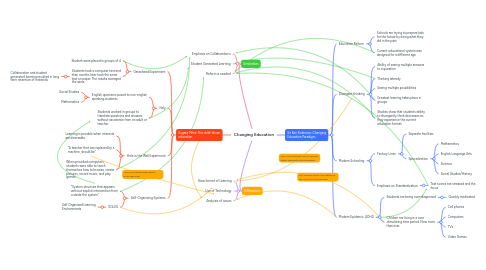
1. Sugata Mitra: The child-driven education
1.1. Gateshead Experiment
1.1.1. Student were placed in groups of 4
1.1.2. Students took a computer test and then months later took the same test on paper. The results averaged the same
1.1.2.1. Collaboration and student generated learning resulted in long term retention of materials
1.2. Italy
1.2.1. English questions posed to non-english speaking students
1.2.1.1. Social Studies
1.2.1.2. Mathematics
1.2.2. Students worked in groups to translate questions and answers without assistance from an adult or teacher
1.3. Hole in the Wall Experiment
1.3.1. Learning is possible when interests are desireable
1.3.2. "A teacher that can replaced by a machine, should be"
1.3.3. When provided computers, students were able to teach themselves how to browse, create pictures, record music, and play games
1.4. Self-Organizing Systems
1.4.1. "System structure that appears without explicit intervention from outside the system"
1.4.2. SOLES
1.4.2.1. Self Organized Learning Environments
2. Sir Ken Robinson: Changing Education Paradigm
2.1. Education Reform
2.1.1. Schools are trying to prepare kids for the future by doing what they did in the past
2.1.2. Current educational system was designed for a different age
2.2. Divergent thinking
2.2.1. Ability of seeing multiple answers to a question
2.2.2. Thinking laterally
2.2.3. Seeing multiple possibilities
2.2.4. Greatest learning takes place in groups
2.2.5. Studies show that students ability to divergently think decreases as they experience the current education format
2.3. Modern Schooling
2.3.1. Factory Lines
2.3.1.1. Separate facilities
2.3.1.2. Specialization
2.3.1.2.1. Mathematics
2.3.1.2.2. English Language Arts
2.3.1.2.3. Science
2.3.1.2.4. Social Studies/History
2.3.2. Emphasis on Standardization
2.3.2.1. Test scores are stressed and the focus
2.4. Modern Epidemic: ADHD
2.4.1. Students are being over-diagnosed
2.4.1.1. Quickly medicated
2.4.2. Children are living in a over stimulating time period. Now more than ever.
2.4.2.1. Cell phones
2.4.2.2. Computers
2.4.2.3. TVs
2.4.2.4. Video Games