
Grammar, Meaning, and Concepts: A Discourse-Based Approach to English Grammar


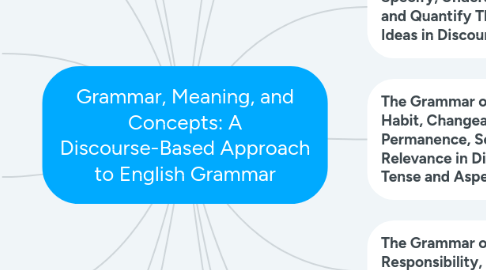
1. GENERAL INFORMATION
1.1. to raise awareness about discourse, grammar, and meaning in all facets of everyday life
1.2. this book puts grammar in the context of real language and illustrates grammar in use through an abundance of authentic data examples
1.3. Each chapter also provides a variety of activities that focus on grammar, genre, discourse, and meaning, which can be used as they are or can be adapted for classroom practice
1.4. focuses on the meanings of grammatical constructions within discourse
1.5. This text emphasizes the ways in which users of language construct meaning, express viewpoints, and depict imageries using the conceptual, meaning-filled categories that underlie all of grammar
1.6. ideal textbook for those in the areas of teacher education, discourse analysis, applied linguistics, second language teaching, ESL, EFL, and communications
2. The Basic Grammar for Mentioning People, Ideas, Values, Objects, Concepts, and Things: Nouns and Their Meanings in Discourse
3. Referring to, Identifying, Specifying, Underspecifying, Possessing, and Quantifying Things, People, and Ideas in Discourse: Determiners
4. The Grammar of Events, States, Identities, Actions, Power, Control, and Spontaneity in Discourse: Verbs
5. The Grammar of Directives, Permissions, Obligations, Opinions, and Mitigations: Imperatives and Modals
6. The Grammar of Juxtaposing, Contrasting, Den ying, Excluding, Contradicting, and Reversing: Negation
7. The Grammar of Situating Entities in Space, Time, and Abstractness, Hanging On, Burning Up, and Cooling Down: Prepositions and Phrasal Verbs
8. The Grammar of Connecting, Adding, Conjoining, Contrasting, Indicating Alternatives, and Expressing Stance: Conjunctions
9. Meaning Beyond Syntax: Discourse and Conceptualization
9.1. grammatical structures are meaningful in and of themselves and that, similar to our word choices, our grammatical choices have the power to create and communicate meaning
9.2. an approach to grammar and discourse that reveals meaning from a conceptual perspective, focusing on the ways in which users of language express viewpoints, stances, and information and depict imageries using the conceptual categories that underlie all of grammar within discourse
9.3. we view grammar and conceptual meaning as integrally and inextricably linked to discourse and genre
9.4. Grammar involves the choice of certain forms over other possible competing forms, each evoking a difference in the speaker’s or writer’s perspective or perception of an event, a difference in the degree of responsibility assigned to an entity active in the discourse, or a difference in stance vis-à-vis the topic or issue at hand
9.5. Grammatical choice influences how we shape, create, organize, and understand discourse within the multiplicity of discourse genres
9.6. the explanations and review sections in this book cycle back and re-introduce other relevant and related bits of grammar that contribute integrally to the meaning and imageries expressed in the data samples
9.7. rules of grammar are presented as the system of language through which speakers and writers organize thoughts, experiences, ideas, perceptions, and stances.
9.8. students leave our courses and workshops with a keen sensitivity to the nuances of meaning created through choices of grammatical forms and structures and, generally, a keen sensitivity to how language is used—everywhere
9.9. For speakers and writers, teachers, learners, and users of language, this enhanced awareness of language and discourse not only improves our skills in oral and written communication but also helps us see beyond the words, beyond the literal, and beyond the surface,
9.10. Our approach to grammar is designed to guide learners and teachers of English to become more keenly aware of meaning and its connection to grammar—from the more obvious types of distinctions like singular vs. plural or present tense vs. past tense to the more subtle ones
9.11. Contrasts like these are most clearly disambiguated by examining the actual discourse and genre in which they were produced and by considering the various possible stances (or attitudes) of the speaker or write
9.12. literal, strictly denotative meanings of words are actually quite uncommon, since genre, context, and surrounding discourse all affect and color the meanings of words
9.12.1. Literal interpretations of language make for interesting imaginary scenarios but often not realistic ones.
9.12.2. The meanings of phrasal verbs change significantly with literal and figurative interpretations:
9.12.3. meanings of words depend on context, the speaker(s), the addresse(s), and the genre(s)
10. The Nuts and Bolts of Grammar
10.1. This chapter provides a general overview of the terms that are often used in grammatical descriptions and analyses
10.2. We provide definitions of those terms as well as examples
10.3. 2.1 Words
10.3.1. A word is the smallest meaningful unit of language that stands alone and that labels or modifies a concept, an idea, an action, or a state. A word can also fulfill a grammatical function. In English, we can typically detect the beginning and end of a written word because it has blank space on each side. Boundaries in spoken words are more difficult to discern.
10.3.2. The relationship between the meaning of a word and the sound or shape of a word in English is typically arbitrary. That is, we understand what the word means, both literally and figuratively, through convention
10.3.2.1. Nothing in the sound or spelling of the words will give you a hint of what the words mean. The word red on its own does not resemble the primary color that we find next to orange at the end of the visible spectrum
10.3.3. the meanings of all words are multi-layered:
10.3.3.1. The literal and objective meanings that we find in a dictionary are referred to as the denotational meanings.
10.3.3.2. The other layers of subjective meaning that are implied through the use of a particular word are referred to as the connotational meanings
10.3.3.2.1. Connotations
10.4. 2.1.1 Words That Sound Like Their Meanings: Onomatopoeia
10.4.1. Onomatopoeia is the sound of the word resembles the meaning of the word
10.4.1.1. animal sounds:
10.4.1.2. anatomical sounds:
10.4.1.3. machine sounds:
10.4.1.4. impact sounds:
10.4.1.5. nature sounds: