

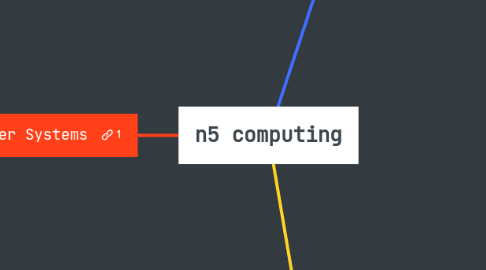
1. Computer Systems
1.1. Computer structures
1.1.1. Buses
1.1.1.1. Data bus
1.1.1.2. Address bus
1.1.1.3. Control bus
1.1.2. Registers
1.1.3. Processor
1.1.3.1. ALU (Arithmetic and Logic Unit)
1.1.3.2. Control Unit
1.1.4. Translators
1.1.4.1. Compiler
1.1.4.2. Interpreter
1.2. Environmental impact
1.3. Security precautions
1.3.1. Firewalls
1.3.2. Encryption
1.4. Data representation
1.4.1. Binary
1.4.1.1. Convert binary to denary
1.4.1.2. Convert denary to binary
1.4.1.3. Representing integers as binary
1.4.2. Floating point representation
1.4.3. Extended ASCII
1.4.4. Vector graphics
1.4.5. Bit mapped
2. SDD
2.1. Development methodologies
2.1.1. iterative
2.2. Analysis
2.2.1. Identify the purpose of a software development problem
2.2.2. Identify the functional requirements (inputs, processes, outputs) of a problem
2.3. Design
2.3.1. Identify the data types needed to solve a problem
2.3.2. Identify the data structures needed to solve a problem
2.3.3. Read and understand structure diagrams
2.3.4. Read and understand flowcharts
2.3.5. Read and understand pseudocode
2.3.6. Use wireframes for user-interface design
2.4. Implementation
2.4.1. Computational constructs
2.4.2. Data types and constructs
2.4.2.1. int
2.4.2.2. str
2.4.2.3. float
2.4.2.4. boolean
2.4.2.5. 1D array
2.4.3. Algorithm specific
2.5. Testing
2.5.1. Describe and use normal test data in a test table
2.5.2. Describe and use extreme test data in a test table
2.5.3. Describe and use exceptional test data in a test table
2.5.4. Errors
2.5.4.1. Identify execution errors
2.5.4.2. Identify syntax errors
2.5.4.3. Identify logic errors
2.6. Evaluate
2.6.1. Evaluate a software solution in terms of fitness for purpose
2.6.2. Evaluate a software solution in terms of efficient use of code
2.6.3. Evaluate a software solution in terms of robustness
2.6.4. Evaluate a software solution in terms of readability
3. DDD
3.1. Analysis
3.1.1. End user requirements
3.1.2. Functional requirements
3.2. Design
3.2.1. GDPR
3.2.2. Entity
3.2.3. Attribute
3.2.4. PK/FK
3.2.5. Describe and use ___
3.2.6. Entity relationship diagram
3.2.7. Data Dictionary
3.3. Implementation
3.3.1. Link tables in a relational database
3.3.2. Enforce referential integrity on linked tables in a relational database
3.3.3. Describe and use SQL select operations