


Ethical TPC's
por Matthew Guerra
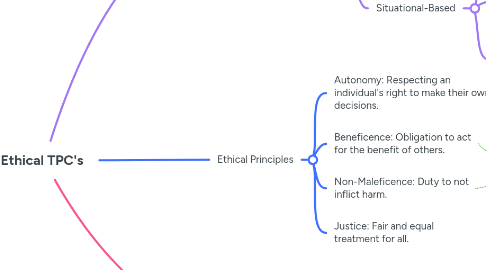
1. Ethical Principles
1.1. Autonomy: Respecting an individual's right to make their own decisions.
1.2. Beneficence: Obligation to act for the benefit of others.
1.3. Non-Maleficence: Duty to not inflict harm.
1.4. Justice: Fair and equal treatment for all.
2. Ethical Concepts
2.1. Action-Based
2.1.1. Non-Consequentialism: Ethical theory that the consequences of an action do not determine its moral value.
2.1.2. Consequentialism: Belief that the morality of an action is based on its outcomes or consequences.
2.2. Agent-Based
2.2.1. Virtue: Focuses on the inherent character of a person rather than on specific actions.
2.3. Situational-Based
2.3.1. Casuistry: Case-based reasoning in ethics.
2.3.2. Relativism: Idea that moral principles are not absolute but vary with context.
2.3.3. Feminism: Perspective that considers how gender impacts ethical decisions and justice.
3. Ethical Theories
3.1. Utilitarianism: An ethical theory suggesting that the best action maximizes overall happiness or utility.
3.2. Deontological: Ethical theory that emphasizes duties and rules.
3.3. Natural Law: Theory proposing that moral principles are found in the natural order of things.
4. Nature of Problems
4.1. - Wrong vs. Wrong: Ethical situations where two choices are both unethical.
4.2. - Wrong vs. Right: Scenarios where an unethical option is pitted against an ethical one.
4.3. - Right vs. Right: Dilemmas involving two competing ethical choices.
4.3.1. - Ethical Dilemma: A complex situation that involves a difficult moral choice.
4.3.1.1. - Stakeholders: Individuals or groups who are affected by or have an interest in the ethical decision.