


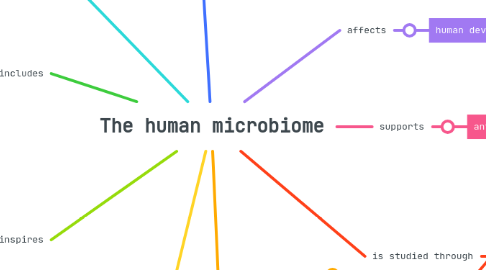
1. plays
1.1. a role in cancer diagnosis, pathogenesis, and treatment
1.1.1. through
1.1.1.1. promoting carcinogenesis
1.1.1.2. modulating metastasis
2. includes
2.1. the skin microbiome
2.1.1. which trains and supports
2.1.1.1. the immune system
2.1.2. enhances
2.1.2.1. regeneration
2.1.2.1.1. through
2.1.3. can be engineered to induce
2.1.3.1. an immune response against tumors
2.1.3.1.1. where
3. inspires
3.1. new approaches to treat neurological disorders
3.1.1. such as
3.1.1.1. Autism spectrum disorder
3.1.1.2. Parkinson's disease
3.1.1.3. Alzheimer's disease
3.1.1.4. Amyotrophic lateral sclerosis
3.1.1.5. Multiple sclerosis
3.1.2. through
3.1.2.1. psychobiotics
4. is impacted bidirectionally by
4.1. chronic stress
5. challenges
5.1. our concept of the self
5.1.1. as a
5.1.1.1. metaorganism
5.1.1.1.1. leading to
6. affects
6.1. human development
6.1.1. through
6.1.1.1. the evolving inner self from the prenatal stage
6.1.1.1.1. helping the
6.1.2. evidenced by
6.1.2.1. the fetal basis of diseases
6.1.2.1.1. often caused by
7. supports
7.1. anti-viral immunity
8. is studied through
8.1. Bioinformstics pipelines and genetic sequencing techniques
8.1.1. such as
8.1.1.1. alpha and beta diversity
8.1.1.1.1. which are defined as
8.1.1.2. 16s rRNA gene sequencing
9. is connected to
9.1. the central nervous system
9.1.1. through
9.1.1.1. the gut-brain axis
9.1.1.1.1. which has various signalling pathways such as:
9.1.1.1.2. bidirectionally impacts
9.1.1.1.3. which has impacts on
9.1.2. which affects
9.1.2.1. synaptic plasticity