Unlock the full potential of your projects.
Try MeisterTask for free.
Não tem uma conta?
Criar conta gratuita
Navegar
Mapas em destaque
Categorias
Gerenciamento de projetos
Negócios e metas
Recursos Humanos
Brainstorming e Análise
Marketing e Conteúdo
Educação e Notas
Entretenimento
Vida
Tecnologia
Design
Resumos
Outro
Idiomas
English
Deutsch
Français
Español
Português
Nederlands
Dansk
Русский
日本語
Italiano
简体中文
한국어
Outro
Exibir mapa completo
Copiar e editar mapa
Copiar
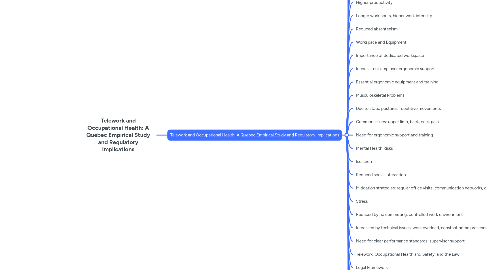
Telework and Occupational Health: A Quebec Empirical Study and Regulatory Implications
Outro
Sergio Erick Ortega Pitta
Seguir
Começar.
É Gratuito
Cadastrar-se com Google
ou
inscrever-se
com seu endereço de e-mail
Mapas mentais semelhantes
Esboço do mapa mental
Telework and Occupational Health: A Quebec Empirical Study and Regulatory Implications
por
Sergio Erick Ortega Pitta
1. Telework and Occupational Health: A Quebec Empirical Study and Regulatory Implications
1.1. Introduction
1.2. Telework Evolution
1.3. Technological advancements
1.4. Increased flexibility
1.5. Essay Objectives
1.6. Identify health risks
1.7. Overview of empirical research
1.8. Examine legal frameworks
1.9. Study Overview
1.10. Research by Montreuil and Lippel (2003)
1.11. Conducted by CEFRIO
1.12. Involved government, private companies, unions
1.13. Data from 6 organizations
1.14. Interviews with 63 teleworkers, managers, union representatives
1.15. Characteristics of Teleworkers and Working Conditions
1.16. Demographics
1.17. Age: 36-45 years
1.18. Gender: 60% women
1.19. Job Roles: Support positions, professionals, sales representatives
1.20. Work Arrangements
1.21. Full-time home-based work
1.22. Varying in-office meeting frequencies
1.23. Inadequate telework-specific training
1.24. Recognized Health Issues Associated with Telework
1.25. Schedule and Absences
1.26. Higher productivity
1.27. Longer work hours, higher work intensity
1.28. Reduced absenteeism
1.29. Workspace and Equipment
1.30. Importance of dedicated workspace
1.31. Inconsistent employer ergonomic support
1.32. Essential ergonomic equipment and training
1.33. Musculoskeletal Problems
1.34. Due to static postures, repetitive movements
1.35. Common issues: upper limb, back, neck pain
1.36. Need for ergonomic support and training
1.37. Mental Health Risks
1.38. Isolation
1.39. Reduced social interaction
1.40. Mitigation strategies: regular office visits, communication networks, colleague contact
1.41. Stress
1.42. Reduced by no commuting, controlled work environment
1.43. Increased by technical issues, work overload, constant home presence
1.44. Need for clear performance standards, supervisor support
1.45. Telework, Occupational Health and Safety, and the Law
1.46. Legal Framework
1.47. Quebec's OHS and workers' compensation legislation apply to teleworkers
1.48. Confusion about rights, underreporting of injuries
1.49. Need for clearer regulations, better information dissemination
1.50. Accommodation for Injured or Disabled Workers
1.51. Telework as reasonable accommodation
1.52. Legal provisions support telework for specific health needs
1.53. Conclusion
1.54. Benefits of Telework
1.55. Reduced commuting stress
1.56. Better work-life balance
1.57. Improved concentration
1.58. Challenges
1.59. Isolation
1.60. Ergonomic issues
1.61. Legal ambiguities
1.62. Recommendations for Employers
1.63. Provide ergonomic support
1.64. Clear information on health and safety rights
1.65. Maintain regular contact with teleworkers
1.66. Acknowledgements
1.67. Contributors
1.68. Irène Le Bot (data collection)
1.69. Isabelle Fournier (literature review)
1.70. CEFRIO (support)
1.71. Rachel Cox, Jacques Desmarais (legal analysis)
Comece Já. É grátis!
Conectar-se com Google
ou
Inscrever-se