


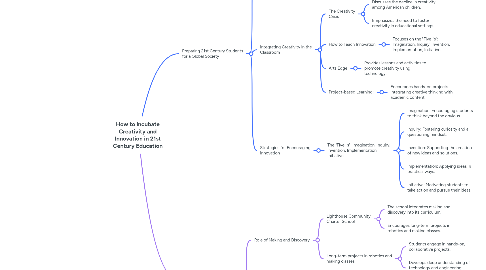
1. Preparing 21st Century Students for a Global Society
1.1. Importance of Creativity
1.1.1. Creativity as a key driver in the global economy
1.1.1.1. Creativity is essential in a global economy characterized by automation and competition.
1.1.1.2. Creative skills enable individuals to adapt and innovate.
1.1.2. Benefits of creativity for personal and professional success
1.1.2.1. Encourages personal growth and adaptability.
1.1.2.2. Enhances professional success by fostering problem-solving and innovative thinking.
1.2. Integrating Creativity in the Classroom
1.2.1. The Creativity Crisis
1.2.1.1. Discusses the decline in creativity among American children.
1.2.1.2. Emphasizes the need to foster creativity in educational settings.
1.2.2. How to Teach Innovation
1.2.2.1. Focuses on the "Five I’s": Imagination, Inquiry, Invention, Implementation, Initiative.
1.2.3. Arts Edge
1.2.3.1. Provides lessons and activities to promote creativity using technology.
1.2.4. Project-based Learning:
1.2.4.1. Encourages hands-on projects integrating creative thinking with academic content.
1.3. Strategies for Encouraging Innovation
1.3.1. The "Five I’s": Imagination, Inquiry, Invention, Implementation, Initiative
1.3.1.1. Imagination: Encouraging students to think beyond the obvious.
1.3.1.2. Inquiry: Fostering curiosity and a questioning mindset.
1.3.1.3. Invention: Supporting the creation of new ideas and solutions.
1.3.1.4. Implementation: Applying ideas in practical ways.
1.3.1.5. Initiative: Motivating students to take action and pursue their ideas.
2. How to Incubate Creativity in School
2.1. Role of Making and Discovery
2.1.1. Lighthouse Community Charter School
2.1.1.1. The school integrates making and discovery into its curriculum.
2.1.1.2. Encourages long-term projects in robotics and making classes.
2.1.2. Long-term projects in robotics and making classes
2.1.2.1. Students engage in hands-on, collaborative projects.
2.1.2.2. Develops deep understanding of technology and engineering principles.
2.2. Real-world Problem Solving
2.2.1. Students engage in solving authentic problems
2.2.1.1. Projects address actual community or global challenges.
2.2.1.2. Makes learning relevant and engaging by applying knowledge in real-world contexts.
2.3. Hands-on Projects:
2.3.1. Integration of creative practices in everyday learning
2.3.1.1. Hands-on projects are embedded in the daily curriculum.
2.3.1.2. Promotes active learning, experimentation, and reflection.