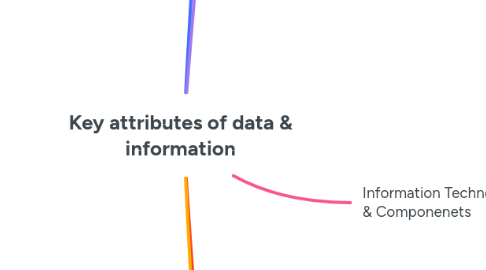
Key attributes of data & information

Começar. É Gratuito
ou inscrever-se com seu endereço de e-mail
Key attributes of data & information por Mind Map: Key attributes of data & information

1. Data Attribures

1.1. Quality - Degree to which data is accurate, complete & reliable.

1.2. Integrity - Maintaining data accuracy & consistency over its lifecycle.

1.3. Accuracy - Correctness & precision of data

1.4. Timeliness - Availability of data when needed.

1.5. Appropriateness - Relevance and suitability of data forn the intended purpose.

2. Data Limitations

2.1. Incompleteness - Missisng data / incomplete data sets.

2.2. Inaccuracy - Errors / inaccuracies in data.

2.3. Bias - Data reflecting prejudice / skwed perspectives.

2.4. Obsolescence - Data becoming outdated / irrelevant over time.

3. Information Technology Concepts & Componenets

3.1. Networks - Systems for data communication between computers. eg. LAN, WAN, Internet.

3.2. Storage Devices - Hardware used to store data. eg. SSD's, HDDs, NAS.

3.3. Operating systems - Software that manageds hardware & software resources. eg. Windows, macOS.

3.4. Information Retrieval - Obtaining information from databases. eg. search engines.

3.5. Data Warehousing - Centralized repository for storing large volumes of data. eg. Amazon.

3.6. Applications - Software designed to perform specific tasks. eg. MS Office, Adobe.

3.7. Firewalls - Security systems to monitor & control incoming & outgoing network traffic. eg. Palo Alto Networks.

3.8. Cloud Computing - Delivery of computing services over the internet. eg. AWS, Microsoft Azure.

3.9. Electronic Health Recoprds (EHRs) - Digital version of patients' paper charts with benefits of improvede patient care, streamlined processes.

3.10. Virtual Reality - Simulated experience using computer technology. eg Gaming, training, education.

3.11. Telehealth - Distribution of health-related services via electronic information & telecommunication technologies. - Benefits: Remote patient monitoring, virtual consultations.

3.12. Wearable Devices - Electronics worn on the body to track health metrics. eg. smartwatches, fitness trackers.

3.13. Artificial Intelligence (AI) - Technology that enables machines to perform tasks that typically require human intelligence, such das learning & problem-solving.

3.14. Big Data - Large & complex data sets that traditional data processing software cant manage. - Technologies: Hadoop, Spark.

4. Relationships and Interactions

4.1. Quality data leads to high-quality information

4.2. Information Technology Enhances Data - IT systems improve datra quality, intergrity & timeliness.

4.3. Limitations Mitigated by Technology - Bias can be reduced with AI. - Obsolescence adressed by cloud computing and real-time data processing.

5. Strengths and Weakness of IT Solutions

5.1. Strengths - Enhanced data storage & retrieval. - Improved accuracy & integrity through automated proc ess. - Realtime data processing.

5.2. Weaknesses - Potential for data breaches & security issues - Dependency on technology infrustructure. - High costs & maintenance requirements.