
SWOT and PEST Done Right

This SEO-friendly description guides users through a comprehensive mindmap titled SWOT and PEST Done Right. It explores the definitions, applications, structure, and interrelations of SWOT and PEST analyses, key tools for strategic planning in business and project management. It delves into strengths, weaknesses, opportunities, and threats (SWOT) and assesses political, economic, sociocultural, and technological (PEST) aspects affecting an organization. The mindmap encourages a holistic view ...

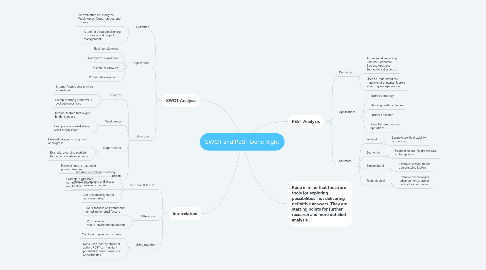
1. SWOT Analysis
1.1. Definition
1.1.1. An evaluation of Strengths, Weaknesses, Opportunities, and Threats
1.1.2. A tool for strategic planning in business and project management
1.2. Applications
1.2.1. Business planning
1.2.2. Competitor evaluation
1.2.3. Marketing strategy
1.2.4. Product development
1.3. Structure
1.3.1. Strengths
1.3.1.1. Internal factors that provide advantage
1.3.1.2. Example: strong brand value, loyal customer base
1.3.2. Weaknesses
1.3.2.1. Internal factors that might hinder success
1.3.2.2. Example: low market share, weak supply chain
1.3.3. Opportunities
1.3.3.1. External prospects for growth or progress
1.3.3.2. Example: emerging markets, technological advancements
1.3.4. Threats
1.3.4.1. External factors that could pose challenges
1.3.4.2. Example: aggressive competition, changing regulations
2. Interrelation
2.1. Both SWOT & PEST
2.1.1. Are used in strategic planning
2.1.2. Help to understand and assess the business environment
2.1.3. Can provide insights for decision-making
2.2. Differences
2.2.1. SWOT focuses on internal and immediate external factors
2.2.2. PEST looks at macro-environmental factors
2.3. Using together
2.3.1. Combine to give holistic view
2.3.2. SWOT can identify areas for action, PEST can highlight potential external barriers or opportunities
3. PEST Analysis
3.1. Definition
3.1.1. A framework assessing Political, Economic, Sociocultural, and Technological aspects
3.1.2. Used to understand the macro-environmental factors affecting an organization
3.2. Applications
3.2.1. Business strategy
3.2.2. Market growth or decline
3.2.3. Business position
3.2.4. Potential direction for operations
3.3. Structure
3.3.1. Political
3.3.1.1. Example: political stability, tax policies
3.3.2. Economic
3.3.2.1. Example: economic growth rate, exchange rates
3.3.3. Sociocultural
3.3.3.1. Example: cultural trends, demographic factors
3.3.4. Technological
3.3.4.1. Example: technological advancements, rate of technological change