
Graves Cultural Leadership Theory

Explore the intricacies of Graves Cultural Leadership Theory through this comprehensive mind map. Covered in the map are the basic premises influenced by Spiral Dynamics and Integral Theory, which state leadership effectiveness relies on the alignment between leader styles and cultural conditions. Dive into the core components, including detailed exploration of the stages of psychosocial development from Beiges SurvivalSense to Turquoises GlobalView and learn about cultural conditions and lea...

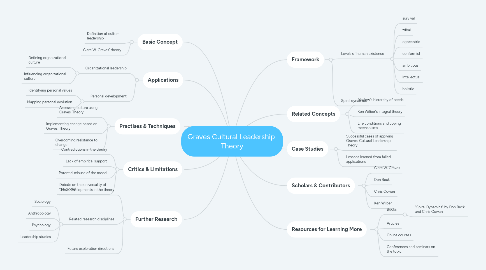
1. Basic Concept
1.1. Definition of cultural leadership
1.2. Clare W. Graves’ theory
2. Applications
2.1. Organizational leadership
2.1.1. Defining organizational culture
2.1.2. Influencing organizational culture
2.2. Personal development
2.2.1. Identifying personal values
2.2.2. Mapping personal evolution
3. Practises & Techniques
3.1. Assessing culture using Graves' Theory
3.2. Implementing change based on Graves' Theory
3.3. Overcoming resistance to change
4. Critics & Limitations
4.1. Contradictions in the theory
4.2. Lack of empirical support
4.3. Potential misuse of the model
4.4. Debate on the universality of the model
5. Further Research
5.1. New developments in the theory
5.2. Related research disciplines
5.2.1. Sociology
5.2.2. Anthropology
5.2.3. Psychology
5.2.4. Leadership studies
5.3. Future exploration directions
6. Framework
6.1. Levels of human existence
6.1.1. survival
6.1.2. tribal
6.1.3. egocentric
6.1.4. conformist
6.1.5. ambitious
6.1.6. intellectual
6.1.7. holistic
6.2. Spiral dynamics
7. Related Concepts
7.1. Maslow's hierarchy of needs
7.2. Ken Wilber's integral theory
7.3. Life conditions and coping mechanisms
8. Case Studies
8.1. Successful cases of applying Graves' Cultural Leadership Theory
8.2. Lessons learned from failed applications
9. Scholars & Contributors
9.1. Clare W. Graves
9.2. Don Beck
9.3. Chris Cowan
9.4. Ken Wilber
10. Resources for Learning More
10.1. Books
10.1.1. "Spiral Dynamics" by Don Beck and Chris Cowan