

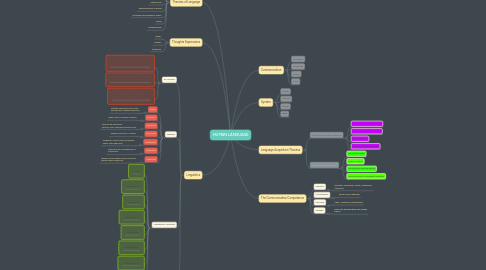
1. Theories of Language
1.1. Structuralism
1.2. Standard theory
1.3. Generative Grammar
1.4. X-bar theory
1.5. Logical Form
1.6. Transformational Grammar
1.7. Principles and Parameters Theory
1.8. Merge
1.9. Panglossianism
2. Thoughts Expressions
2.1. Words
2.2. Phrases
2.3. Sentences
3. Linguistics
3.1. As a Science
3.1.1. OBSERVES AND CLASSIFIES NATURALLY OCURRING PHENOMENA
3.1.2. CAN BE STUDIED IN HUMAN BEHAVIOUR
3.1.3. CONSTRUCTS HYPOTHESES AND TEST THEM BY EXPERIMENTATION
3.2. Subfields
3.2.1. Syntax
3.2.1.1. WORDS ORGANIZATION AND SENTENCES UNDERSTANDING
3.2.2. Phonetics
3.2.2.1. DEALS WITH SPOKEN SOUNDS
3.2.3. Semantics
3.2.3.1. LANGUAGE MEANING. LEXICAL AND SENTENCE SEMANTICS
3.2.4. Phonology
3.2.4.1. SPEECH SOUNDS SYSTEMS
3.2.5. Morphology
3.2.5.1. INTERNAL STRUCTURE OF WORDS. FORM AND MEANING
3.2.6. Pragmatics
3.2.6.1. MEANING OF UTTERENCES IN CONTEXTS.
3.2.7. Lexicology
3.2.7.1. WORDS AND EXPRESSIONS WITHOUT PREDICTABLE MEANING
3.3. 'Hyphenated' Linguistics
3.3.1. Areal
3.3.2. Comparative
3.3.3. Educational
3.3.4. Ethnolinguistics
3.3.5. Mathematical
3.3.6. Neurolinguistics
3.3.7. Psycholinguistics
3.3.8. Sociolinguistics
3.4. Applied Linguistics
3.4.1. THE STUDY OF PROBLEMS WHICH LANGUAGE PRODUCES FOR HUMANS.
4. Communication
4.1. Community
4.2. Collectivity
4.3. Culture
4.4. Social
5. System
5.1. Written
5.2. Gestures
5.3. Spoken
5.4. Signs
6. Language Acquisition Theories
6.1. Nurture (Socio-Cultural Influence)
6.1.1. Theory of Polyphony or Dialogics
6.1.2. Zone of Proximant Development
6.1.3. Verbal Behaviour
6.1.4. View of Language Acquisition
6.2. Nature (Biologically inherent)
6.2.1. The monitor model
6.2.2. Fordor’s Modular
6.2.3. The Universal Grammar Theory
6.2.4. Neurofunctional of Language Acquisition
7. The Communicative Competence
7.1. Linguistic
7.1.1. Phonetics, Phonology, Syntax, Morphology, Semantics
7.2. Sociolinguistic
7.2.1. Social rules of language
7.3. Discourse
7.3.1. Ideas Conection Understanding
7.4. Strategic
7.4.1. Overcome language gaps and achieve fluency