


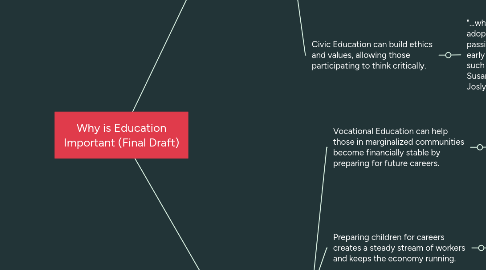
1. Civic Education
1.1. Civic Education helps build informed people who can particpate in democracy.
1.1.1. More specifically, higher educated individuals tend to vote more than those that do not have the same level of education.
1.1.1.1. "In an important 2006 paper, “Why Does Democracy Need Education?” economists Edward L. Glaeser, Giacomo Ponzetto, and Andrei Shleifer argue that education is a causal force behind democracy. Specifically, they point to the relationship between education and participation."
1.2. A civic approach to education can prepare those to become active members in their society and engage in their community and build culture.
1.2.1. "What is more, defending the right to civic education, and the kind of curriculum that delivers it, would benefit not only individual students but also society as a whole, advancing both political equality and distributive justice."
1.3. Civic Education can build ethics and values, allowing those participating to think critically.
1.3.1. "...where a given public actor adopts a cause and pursues it passionately. One might think of early women’s rights activists such as Elizabeth Cady Stanton, Susan B. Anthony, and Matilda Joslyn Gage."
2. Vocational Education
2.1. Vocational Education can help those in marginalized communities become financially stable by preparing for future careers.
2.1.1. "The dominant policy paradigm attends almost exclusively to education’s vocational purpose: the goal is to ensure that young people, and society generally, can compete in a global economy..."
2.2. Preparing children for careers creates a steady stream of workers and keeps the economy running.
2.2.1. "...Piketty agrees that the wage premium on skill can explain only part of growing U.S. income inequality: political forces shape distributive outcomes, and there are limits to how much the advantages of education can be moderated through the dissemination of technological skills."
2.3. Vocational Education can give children practical skills needed for the rest of their lives, including things not needed for a career.
2.3.1. The vocational approach imagines that this equal attainment will translate into a wider distribution of skills, which will reduce income inequality.
2.3.1.1. "...When he [Piketty] considers curriculum, he is explicit only about vocational goals. Thus he argues that educational institutions should be made broadly accessible; elite institutions, which serve mainly privileged youth from the highest income brackets, should draw students from other backgrounds; schools should be run efficiently; and states should increase investment in "high-quality professional training."