


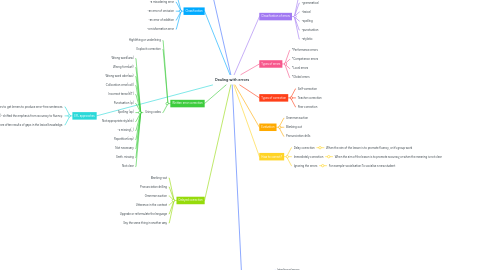
1. Correction techniques
1.1. 1.Elicitation
1.2. 2.Clarification requests
1.3. 3.Metalingguistic
1.4. 4.Explicit correction
1.5. 5.Repetition
1.6. 6.Recast
2. Classification
2.1. -a mis-selection error
2.2. -a misodering error
2.3. -an error of omission
2.4. -an error of addition
2.5. -a misformation error
3. EFL approaches
3.1. Audiolingualism-great effort on the part of teachers to get lerners to produce error-free sentences.
3.2. Communicative Language Teaching (CLT)- shifted the emphasis from accuracy to fluency.
3.3. Lexical Approach-mistakes are often results of gaps in the lexical knowledge.
4. Causes of errors
4.1. Interlingual errors
4.2. Intralingual errors
4.2.1. 1. simplification –learners refuse to use complex forms of a language which, as a final result, appears to be an error.
4.2.2. 2. overgeneralisation –learners apply one structure to different contexts inaccurately.
4.2.3. 3. faulty teaching –learners produce the language incorrectly because of the fact that their teacher, while explaining the language, provides them with confusing materials or presentations.
4.2.4. 4. fossilization –learners begin to use incorrect forms for a longer period of time. This particular problem happens to be extremely difficult to overcome.
4.2.5. 5. avoidance –learners simply avoid using too difficult structures. In such case, they stop the development of the process of learning as well as they are likely to go wrong.
4.2.6. 6. inadequate learning –learners tend to make errors because of the fact that they ignore the rules or they learn incompletely.
4.2.7. 7. false concepts hypothesised –learners incorrectly hypothesise about the target language and its structures.
5. Classification of errors
5.1. •phonological
5.2. •grammatical
5.3. •lexical
5.4. •spelling
5.5. •punctuation
5.6. •stylistic
6. Written error correction
6.1. Highlithing or underlining
6.2. Explocit correction
6.3. Using codes
6.3.1. Wrong word(ww)
6.3.2. Wrong form(wf)
6.3.3. Wrong word oder(wo)
6.3.4. Collocation error(coll)
6.3.5. Incorrect tense(t/T)
6.3.6. Punctuation (p)
6.3.7. Spelling (sp)
6.3.8. Not appropriate style(st)
6.3.9. -s missing(_)
6.3.10. Repetition(rep)
6.3.11. Not necessary
6.3.12. Smth. missing
6.3.13. Not clear
7. Delayed correction
7.1. Blanking-out
7.2. Pronunciation drilling
7.3. Grammar auction
7.4. Utterance in the context
7.5. Upgrade or reformulate the language
7.6. Say the same thing in another way
8. Types of errors
8.1. *Performance errors
8.2. *Competence errors
8.3. *Local errors
8.4. *Global errors
9. Types of correction
9.1. Self-correction
9.2. Teacher correction
9.3. Peer correction
10. Evaluation
10.1. Grammar auction
10.2. Blanking out
10.3. Pronunciation drills
11. How to correct?
11.1. Delay correction
11.1.1. When the aim of the lesson is to promote fluency, or it’s group work
11.2. Immediately correction
11.2.1. When the aim of the lesson is to promote accuracy,or when the meaning is not clear
11.3. Ignoring the errors
11.3.1. For example-socialisation:To socialise a new student