"How the structural Racism works racist policies as a root cause of us racial health inequalities...

Começar. É Gratuito
ou inscrever-se com seu endereço de e-mail
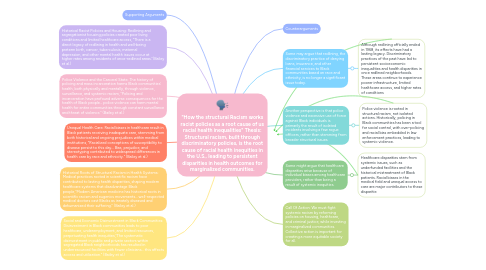
"How the structural Racism works racist policies as a root cause of us racial health inequalities" Thesis: Structural racism, built through discriminatory policies, is the root cause of racial health inequities in the U.S., leading to persistent disparities in health outcomes for marginalized communities. por Mind Map: "How the structural Racism works racist policies as a root cause of us racial health inequalities" Thesis: Structural racism, built through discriminatory policies, is the root cause of racial health inequities in the U.S., leading to persistent disparities in health outcomes for marginalized communities.

1. Supporting Arguments

2. Historical Racist Policies and Housing: Redlining and segregationist housing policies created poor living conditions and limited healthcare access, "There is a direct legacy of redlining in health and well-being preterm birth, cancer, tuberculosis, maternal depression, and other mental health issues occur at higher rates among residents of once-redlined areas."(Bailey et al.)

3. Police Violence and the Carceral State: The history of policing and mass incarceration harms Black communities' health, both physically and mentally, through violence, surveillance, and systemic racism, "Policing and incarceration have profound adverse consequences for the health of Black people... police violence can harm mental health for entire communities through constant surveillance and threat of violence." (Bailey et al.)

4. Unequal Health Care: Racial biases in healthcare result in Black patients receiving inadequate care, stemming from both historical and ongoing prejudices within medical institutions, "Racialized conceptions of susceptibility to disease persist to this day... Bias, prejudice, and stereotyping contributed to widespread differences in health care by race and ethnicity." (Bailey et al.)

5. Historical Roots of Structural Racism in Health Systems: Medical practices rooted in scientific racism have contributed to lasting health disparities, shaping modern healthcare systems that disadvantage Black people,"Modern American medicine has historical roots in scientific racism and eugenics movements... well-respected medical doctors cast Blacks as innately diseased and dehumanized their suffering." (Bailey et al.)

6. Social and Economic Disinvestment in Black Communities: Disinvestment in Black communities leads to poor healthcare, underemployment, and limited resources, perpetuating health inequities,"The systematic disinvestment in public and private sectors within segregated Black neighborhoods has resulted in underresourced facilities with fewer clinicians... this affects access and utilization." (Bailey et al.)

7. Counterarguments

8. Some may argue that redlining, the discriminatory practice of denying loans, insurance, and other financial services to Black communities based on race and ethnicity, is no longer a signfificant issue today.

8.1. Although redlining officially ended in 1968, its effects have had a lasting legacy. Discriminatory practices of the past have led to persistent socioeconomic inequalities and health disparities in once redlined neighborhoods. These areas continue to experience poorer infrastructure, limited healthcare access, and higher rates of conditions

9. Another perspective is that police violence and excessive use of force against Black individuals is primarily the result of isolated incidents involving a few rogue officers, rather than stemming from broader structural issues.

9.1. Police violence is rooted in structural racism, not isolated actions. Historically, policing in Black communities has been a tool for social control, with over-policing and racial bias embedded in law enforcement practices, leading to systemic violence.

10. Some might argue that healthcare disparities arise because of individual biases among healthcare providers, rather than being a result of systemic inequities.

10.1. Healthcare disparities stem from systemic issues, such as underfunded facilities and the historical mistreatment of Black patients. Racial biases in the medical field and unequal access to care are major contributors to these disparitie

11. Call Of Action: We must fight systemic racism by reforming policies on housing, healthcare, and criminal justice, while investing in marginalized communities. Collective action is important for creating a more equitable society for all.