


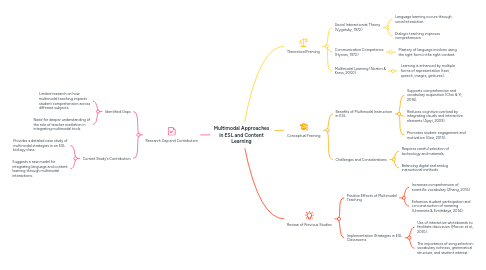
1. Research Gap and Contribution
1.1. Identified Gaps
1.1.1. Limited research on how multimodal teaching impacts student comprehension across different subjects.
1.1.2. Need for deeper understanding of the role of teacher mediation in integrating multimodal tools.
1.2. Current Study’s Contribution
1.2.1. Provides a detailed case study of multimodal strategies in an ESL biology class.
1.2.2. Suggests a new model for integrating language and content learning through multimodal interactions.
2. Theoretical Framing
2.1. Social Interactionist Theory (Vygotsky, 1972)
2.1.1. Language learning occurs through social interaction.
2.1.2. Dialogic teaching improves comprehension
2.2. Communicative Competence (Hymes, 1972)
2.2.1. Mastery of language involves using the right form in the right context.
2.3. Multimodal Learning (Norton & Kress, 2000)
2.3.1. Learning is enhanced by multiple forms of representation (text, speech, images, gestures).
3. Conceptual Framing
3.1. Benefits of Multimodal Instruction in ESL
3.1.1. Supports comprehension and vocabulary acquisition (Choi & Yi, 2016).
3.1.2. Reduces cognitive overload by integrating visuals and interactive elements (Ajayi, 2009).
3.1.3. Promotes student engagement and motivation (Gee, 2015).
3.2. Challenges and Considerations
3.2.1. Requires careful selection of technology and materials.
3.2.2. Balancing digital and analog instructional methods.
4. Review of Previous Studies
4.1. Positive Effects of Multimodal Teaching
4.1.1. Increases comprehension of scientific vocabulary (Zhang, 2016).
4.1.2. Enhances student participation and co-construction of meaning (Urmeneta & Evnitskaya, 2014).
4.2. Implementation Strategies in ESL Classrooms
4.2.1. Use of interactive whiteboards to facilitate discussion (Mercer et al., 2010).
4.2.2. The importance of song selection: vocabulary richness, grammatical structure, and student interest.