
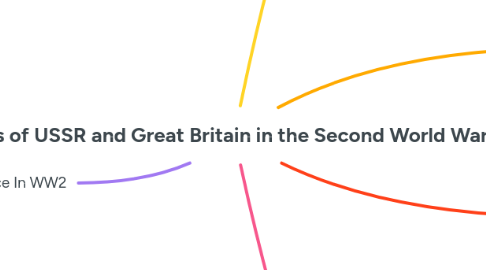
Roles of USSR and Great Britain in the Second World War

describe possible reasons why the axis powers had loss the war in the second world war

1. How did USSR defeat Germany ?
1.1. Internal reorganisation
1.1.1. elimination of incompetent soldiers and generals
1.1.2. Order 227 "not a step back "
1.1.3. Soldiers were given greater freedom to act unlike Germany where every decision has to be made by Hitler Himself . Communist party of Russia forbidden to interfere.
1.2. development of effective resources
1.2.1. Soviet economy depended on both man and woman , unlike Nazi Germany which only relied on man and slaves
1.2.2. devoted all resources to produce useful and effective weapons in large quantity
1.3. effective tactics used in war
1.3.1. Use of Radio communication
1.3.1.1. Special units formed to intercept German messages
1.3.2. Movement of Russian industrial areas far from Germany's reach
1.3.3. Brutal Russian winter
1.3.3.1. Allowed soldiers from russia to regroup and to produce new weapons
1.3.3.2. German soldiers lack necessary supplies such as winter uniforms , causin great losses for germany
1.4. Contribution of Allied powers to USSR
1.4.1. Britain and USA supplied large amount of food , raw materials and equipments to USSR
1.4.2. USA provided the resources needed for war like Motor vehicles and weaponry
2. Battles fought by the USSR
2.1. Battle of moscow (30 september 1941 to 20 april 1942)
2.2. Battle of Stalingrad ( 17 july 1942 to 2 feburary 1943)
2.3. Battle of kursk ( 5th july to august 23 1943)
3. Impact of the defeat on Germany
3.1. Battle of Kursk
3.2. pushed back germany and left them weakened
4. weakness of the Axis
4.1. GERMANY
4.1.1. war on multiple fronts
4.1.1.1. Eastern front (UK) and Western front (USSR)
4.1.1.1.1. overstreched its resources , massive loss of troops
4.1.1.2. direct invlovement of USA after the attacks of pearl harbour
4.1.2. ineffective use of funds
4.1.2.1. factories operated by slaves
4.1.2.2. slow and inefficient arms production
4.1.2.3. shortage of essential equipments like trucks
4.1.2.4. did not focus on building bombers , building giant warships and not enough aircraft carrier
4.1.3. monopolise control of the army
4.1.3.1. examples
4.1.3.1.1. Dunkirk ( may 1940) Battle of Britian ( july 1940)
4.1.3.2. Hitler as the sole decision maker
4.2. JAPAN
4.2.1. tactical blunders
4.2.1.1. Did not cripple USA defences during pearl harbour attacks as aircraft carrier are not at base
4.2.1.1.1. leaving USA to be able to strike back
4.2.2. ineffective use of resources
4.2.2.1. treated occupied people brutally
4.2.2.1.1. resulting ting in resisstance which wear out the army
4.2.3. rivalry between army and navy
4.2.3.1. long term conflict prevents both sides to exchange military intelligence and share resources
4.2.4. overextension of japanese empire
4.2.4.1. japan losing military perosnells and resources such as battleships and aircraft carriers
5. British Resistance In WW2
5.1. Retaliation from the RAF
5.1.1. bombed industrail and military target
5.1.1.1. 75% of hamburg was destroyed
5.2. Significance of British resistance of the Axis
5.2.1. important campaign like D'day
5.2.2. held the western front before USA's support came
5.2.3. British continued resisting japan in Asia -Pacific
5.3. effective tactics used
5.3.1. developmemnt of Radar technology
5.3.2. Britain became a base for USA after USA entered the war
5.3.2.1. made the D'day landings and allied bombing of Germany possible
5.4. Battle of Britain (jul-oct 1940)
5.4.1. Lutfwaffe VS RAF
5.4.1.1. German's tactical blunder
5.4.1.1.1. Attacking coastal defences then switchin to attacking cities
5.4.1.2. Britians good tactics
5.4.1.2.1. Advanced Radar system
5.4.1.2.2. Small Squads scattered across the country which can be mobilised almost immediately