


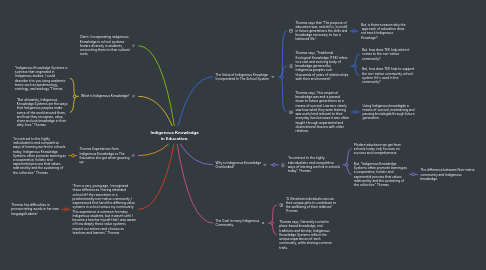
1. Claim- Incorporating indigenous Knowledge in school systems fosters diversity in students, connecting them to thier cultural roots.
2. What is Indigenous Knowledge?
2.1. "Indigenous Knowledge Systems is a phrase that originated in Indigenous studies. I could describe it to you using academic terms such as epistemology, ontology, and axiology."Thomas
2.2. "But ultimately, Indigenous Knowledge Systems are the ways that Indigenous peoples make sense of the world around them, and how they recognize, value, share and use knowledge in their daily lives." Thomas
3. Thomas Experiences from Indigenous Knowledge vs The Education she got when growing up.
3.1. "In contrast to the highly individualistic and competitive ways of learning we find in schools today, Indigenous Knowledge Systems often promote learning as a cooperative, holistic and experiential process that values relationality and the sustaining of the collective." Thomas
4. The Value of Indigenous Knowlege Incorporated In The School System
4.1. Thomas says that "The purpose of education was, and still is, to instill in future generations the skills and knowledge necessary to live a balanced life.".
4.1.1. But, is there a reason why the approach of education does not teach Indigenous Knowlege?
4.2. Thomas says, "Traditional Ecological Knowledge (TEK) refers to a vast and evolving body of knowledge garnered by Indigenous peoples over thousands of years of relationships with their environment."
4.2.1. But, how does TEK help when it comes to the non-native community?
4.2.2. But, how does TEK help to support the non-native community school system if it's used in the community?
4.3. Thomas says, "this empirical knowledge was and is passed down to future generations as a means of survival. Learners clearly saw how what they were learning was useful and relevant to their everyday lives because it was often taught through experiential and observational lessons with older relatives.
4.3.1. Using Indigenous knowlegde a means of survival, maintaining and passing knowlegde through future generation.
5. "From a very young age, I recognized these differences. Having attended school off the reservation in a predominantly non-native community, I experienced first hand the differing value systems in school versus my community. This experience is common for many Indigenous students, but it wasn’t until I became a teacher myself that I was aware of how deeply these value systems impact our actions and choices as teachers and learners." Thomas
5.1. Thomas has difficulties in pronunciating words in her own language(Lakota)
6. Why is Indigenous Knowledge Overlooked?
6.1. "In contrast to the highly individualistic and competitive ways of learning we find in schools today". Thomas
6.1.1. Modern eductaion we get from schools today only focuses on success and competiveness.
6.1.2. But, "Indigenous Knowledge Systems often promote learning as a cooperative, holistic and experiential process that values relationality and the sustaining of the collective." Thomas
6.1.2.1. The difference between Non-native community and Indigenous knowledge.