


Linguistic Anthropology
por Yiming Liu
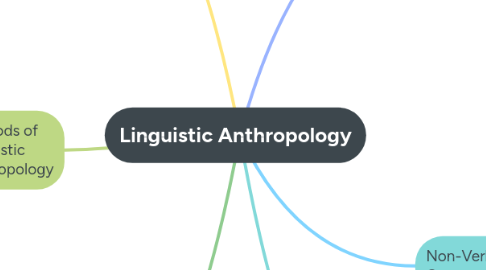
1. History of Linguistic Anthropology
1.1. Four-field approach
1.2. Boas and Sapir
1.3. Americanist tradition
1.4. “Anthropology is the holistic study of humankind” (Salzmann et al., 2018)
1.5. https://www.youtube.com/watch?v=LphKgWHYs0I
2. Methods of Linguistic Anthropology
2.1. “A command of the language is an indispensable means of obtaining accurate and thorough knowledge” (Salzmann et al., 2018).
2.2. Participant observation
2.3. Informants
2.4. Fieldwork
2.5. Transcription
2.6. https://www.youtube.com/watch?v=dfhreK_Tjrc
3. Morphemes and Morphology
3.1. “A morpheme is the smallest contrastive unit of grammar” (Salzmann et al., 2018).
3.2. Free vs. Bound Morphemes
3.3. Affixes
3.4. Inflection vs. Derivation
4. Phonetics and Phonology
4.1. “Phonemes are the smallest distinctive sound unit of a language” (Salzmann et al., 2018).
4.2. Phonemes
4.3. Allophones
4.4. IPA
4.5. Articulatory Phonetics
4.6. https://www.youtube.com/watch?v=ugppjNn8uIE
5. Non-Verbal Communication
5.1. This is the ways communication happens beyond spoken language, including body language and facial expressions.
5.2. Kinesics
5.3. Proxemics
5.4. Paralanguage
5.5. Sign Languages
5.5.1. “Sign language is a system of hand gestures used as an alternative to speech” (Salzmann et al., 2018).