

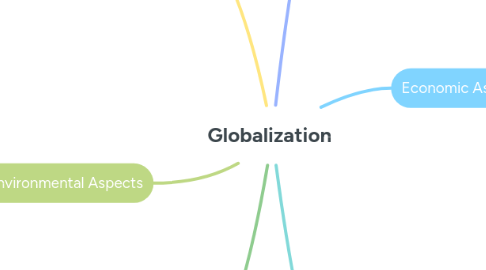
1. Social Impacts of Globalization
1.1. Migration & Refugee Movements
1.1.1. Exploitation of natural resources -> environmental destruction & climate change
1.1.2. Poor living conditions in developing countries —> migration to industrialized nations
1.1.3. War-ravages countries, political oppression, religious persecution —> refugee crises
1.1.4. Resistance in host countries toward migrants (f.e. political nationalism)
1.2. Radicalization & Social Unrest
1.2.1. Rise of radical terrorist groups (f.e. Islamic terrorism) as a response to poverty
1.2.2. Suicide bombings & violent attacks in cities
1.2.3. Strengthening of nationalist & separatist movements (f.e. Brexit)
2. Environmental Aspects
2.1. Overexploitation of natural resources
2.2. Environmental degradation & climate change
2.3. Loss of biodiversity & pollution
2.4. Increased migration due to environmental disasters
3. Cultural Aspects
3.1. Cultural homogenization & loss of diversity
3.1.1. Standardization of cultural expression (f.e. music, food, fashion)
3.1.2. Loss of uniqueness & cultural heritage
3.1.3. Promotion of globalized worldview through media & corporations
3.2. Cultural Benefits
3.2.1. Easier access to global cultures
3.2.2. ability to select cultural elements based on individual preference
4. Definition of Globalization
4.1. Process of interaction and integration between countries, cultures and economic systems
4.2. Affects all aspects of life (economic, technological, cultural, social
5. Economic Aspects
5.1. Positive Effects
5.1.1. Deregulation enables international trade
5.1.2. Investment markets operate globally
5.1.3. Free flow of capital, good, services and labor
5.1.4. Liberalization of markets and privatization
5.1.5. Multinational corporations expand globally (f.e. outsourcing)
5.1.6. Increased competition and innovation
5.1.7. Technological connectivity
5.2. Negative Effects
5.2.1. Inequality between developed and developing countries
5.2.2. Low wages & exploitation in developing nations (f.e. child labor)
5.2.3. Trade agreements may threaten social justice
5.2.4. Erosion of social justice & reduction of social services
5.2.5. Decline in trade unions‘ influence