


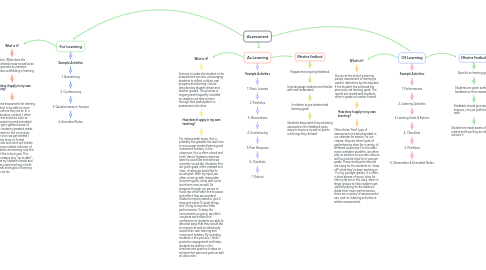
1. For Learning
1.1. Example Activities
1.1.1. 1. Questioning
1.1.1.1. 2. Conferencing
1.1.1.1.1. 3. Questionnaires or Surveys
2. As Learning
2.1. Example Activities
2.1.1. 1. Music Journals
2.1.1.1. 2. Portfolios
2.1.1.1.1. 3. Observations
3. Of Learning
3.1. Example Activities
3.1.1. 1. Performances
3.1.1.1. 2. Listening Activities
3.1.1.1.1. 3. Learning Goals & Rubrics
4. What is it?
4.1. Diagnostics, What does the student already know as well as an ongoing process to maintain appropriate scaffolding in learning.
4.1.1. How does it apply in my own teaching?
4.1.1.1. Often I find assessment for learning as a key tool to be able to reach students where they are at. In a music education context, I often use informal activities such as group questioning and anecdotal notes to get a general sense of what the students greatest needs are in relation to the curriculum. However once we get started I tend to rely more on formal conferences and short exit tickets to get a more reliable indicator of how students are learning over the course of the school year. This helps me always stay "up to date" with what my students needs and informs my own teaching in both it's material and types of learning activities we do.
5. What is it?
5.1. Occurs at the end of a learning period, assessment of learning is used to determine by the educator if the student has achieved the previously set learning goals. The results are shared with students, often in grade or number format.
5.1.1. How does it apply in my own teaching?
5.1.1.1. Often these "final" type of assessments are benchmarked in our calendar for weeks. For our classes, they are often types of performances done for a variety of different audiences. For the older more confident students, we often play as sections to our own class as well as a whole class for a younger grade. These small performances are a way for the students to "show off" what they've been working on . For my younger grades, it is often a short phrase of music done for either just me or the class, often in larger groups to help students get used to playing for an audience. Aside from music performances, there are a variety of assessments I use, such as listening activities or written assessments
6. What is it?
6.1. Actively includes the student in the asssessment process, encouraging students to reflect on their own progress and learning. Can be described as student driven and teacher guided. This process is ongoing and frequently revisited, as students are able to learn through their participation in assessment activities
6.1.1. How does it apply in my own teaching?
6.1.1.1. For instrumental music, this is probably the greatest tool we have to encourage student learning and instrument mastery. In the classroom, this is often a back and forth "dance" between what we want to sound like and what we currently sound like. Students first are given goals, often created as a class, of what we would like to accomplish. With my input, we often come up with reasonable long term goals, along with some short term ones as well. As progress through our pieces of music we often take time to pause and reflect how we sounded. Students may be asked to give 2 stars and a wish (2 good things, and 1 thing to improve) after performances. To keep the conversation on going, we often complete exit tickets and conference so students are able to describe ways that they would like to improve as well as realistically assess their own learning and instrument mastery. By including students in the process, I find it promotes engagement and helps students be realistic in the timelines and practice it takes to achieve their personal goals as well as class ones.
7. Effective Feedback
7.1. Regular and ongoing feedback
7.1.1. Uses language students are familiar with and understand
7.1.1.1. In relation to pre-determined learning goals
7.1.1.1.1. Students know what they are being assessed on the feedback gives ways to improve as well as points out things they did well
8. Effective Feedback
8.1. Specific to learning goals
8.1.1. Students are given authentic feedback on their assessment
8.1.1.1. Feedback should give ways to improve, not just justification of mark
8.1.1.1.1. Student are made aware of success criteria and how they are able to achieve it