


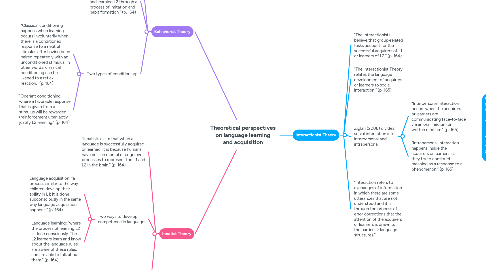
1. Behaviorist Theory
1.1. “Behaviorism gave birth to stimulus-response theory which strives to explain L2 learning as the acquisition of a set of structures through the process of habit formation.” (p.163)
1.2. “Behaviorists explain the success on acquiring L1 and learning L2 through a process of imitation and habit formation.” (p. 164)
1.3. Two types of conditioning:
1.3.1. “Classical conditioning happens when learning occurs involuntarily when there is a conditioned response to a neutral stimulus after having been paired repeatedly with an unconditioned stimulus. In other words, classical conditioning can be likened to a reflex reaction.” (p. 164)
1.3.2. “Operant conditioning, where a favorable response that is given from a stimulus will be rewarded (reinforcement), can aptly justify L2 learning.” (p. 164)
2. Innatist Theory
2.1. “Innatists claim that when a language is successfully acquired or learned, it is because humans have built-in mental or cognitive processes to represent the L1 and L2 in the brain.” (p. 164)
2.2. Two ways to develop competence in language:
2.2.1. Language acquisition: “a process similar to the way children develop their ability in L1; it is done subconsciously in the same way language acquisition happens.” (p. 164)
2.2.2. Language learning: “where the process of learning L2 is done consciously. The L2 learners learn and know about the language rules, are aware of these rules, and are able to talk about them.” (p. 164)
2.3. The main domain of Innatism:
2.3.1. Language Acquisition Device (LAD): “an innate template or blueprint for language”. (p. 162)
2.3.2. Universal Grammar (UG): “explains the commonality of how children acquire language by learning rules in L1 which are presumed to be universal”. (p.162)
3. Interactionist Theory
3.1. “The Interactionists believe that group-related tasks account for the successful acquirers of L1 or learners of L2.” (p. 164)
3.2. “The Interactionist Theory relates the language development of acquirers or learners to social interaction.” (p. 165)
3.3. Ziglari (2008) divides social interaction into interpersonal and intrapersonal:
3.3.1. “Interpersonal interaction occurs when the acquirers or learners are communicating face-to-face via an oral medium or written medium.” (p. 165)
3.3.2. “Intrapersonal interaction happens inside the acquirers or learners as they try to construct meaning as a response to a phenomenon.” (p. 165)