
World languages, language death, and language revitalization


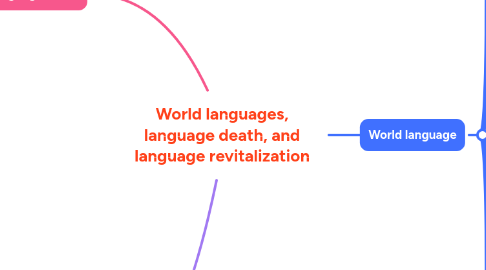
1. Language death
1.1. Knowledge & Tradition
1.1.1. Medicinal Knowledge: Maya language loss = lost plant-based cancer treatments
1.1.2. Disaster Survival: Moken people’s language saved them from 2004 tsunami
1.1.3. Navigation Skills: Polynesian ocean navigation fading
1.2. Cultural Heritage
1.2.1. Myths & Stories: Native American, Aboriginal (Dreamtime stories) vanish
1.2.2. Oral Traditions: Unwritten languages = high risk of erasure
1.2.3. Religious Language Loss: Latin & Sanskrit prayers misunderstood today
1.3. Human Cognition & Perception
1.3.1. Language Shapes Thought
1.3.2. Urarina: rare Object-Verb-Subject (O-V-S) structure
1.3.3. -Piraha: No words for numbers → no counting system
1.3.4. Hopi: No strict past/future tense → different time perception
2. Language revitalization
2.1. First
2.1.1. Gather surviving speakers
2.1.2. Create records
2.2. Teach
2.2.1. Host cultural events
2.2.2. Teach children first
2.2.3. Create materials
2.3. Making it relevant against
2.3.1. Pop culture integration
2.3.2. Festivals and events
3. World language
3.1. Language Family
3.1.1. French belongs to the Romance branch of the Indo-European language family.
3.1.2. English belongs to the West Germanic branch of the Indo-European language family.
3.2. Shared Characteristics
3.2.1. French and English share a large number of vocabulary items due to historical contact, especially after the Norman Conquest in 1066.
3.2.2. Many English words come from French, especially in areas like law, art, and cuisine.
3.3. Writing System
3.3.1. Both use the Latin alphabet with 26 letters.
3.3.2. French uses five diacritical marks on vowels, while English does not use any diacritics.
3.4. Pronunciation & Grammar
3.4.1. French has nasal vowels and more vowel sounds than English.
3.4.2. It uses gendered nouns (masculine and feminine) and has a more complex system of verb conjugation.
3.4.3. English has no gender in nouns and relies more on word order and auxiliary verbs to express tense.
3.5. Cultural Differences
3.5.1. French communication tends to be more formal and polite.
3.5.2. English speakers, especially in the UK and US, tend to communicate more directly and informally.
3.6. World Language Families
3.6.1. Language Groups: Shared ancestry, proto-languages
3.6.2. Mistaken Grouping: Typological similarities ≠ genetic relationship
3.6.3. Language Contact: Borrowing vocabulary, structural features
3.7. Causes of Language Change
3.7.1. Historical Events: Conquests, colonization, migration
3.7.2. Cultural Exchange: Trade, globalization, technology
3.7.3. Internal Changes: Grammar, vocabulary simplification/innovation
3.8. Vietnamese Language Evolution
3.8.1. Writing System: Chữ Nôm → Quốc Ngữ
3.8.2. Influence: Chinese, French, English borrowings
3.8.3. Modern Evolution: Internet, technology terms
3.9. Regional Dialects & Language Distinction
3.9.1. Mutual Intelligibility: Dialect vs. language debate
3.9.2. Chinese Dialects: Mandarin, Cantonese (unintelligible but called dialects)
3.9.3. Chinese Dialects: Mandarin, Cantonese (unintelligible but called dialects)
3.9.4. Scandinavian Languages: Danish, Norwegian, Swedish (intelligible but separate languages)
3.10. Diversity of Languages
3.10.1. 7,000 Languages: Uneven distribution
3.10.2. Major Languages: Mandarin, English, Spanish
3.10.3. Language Families: Indo-European, Afro-Asiatic
3.10.4. Tonal vs. Non-Tonal: Mandarin (tonal), sign languages (non-verbal cues)