


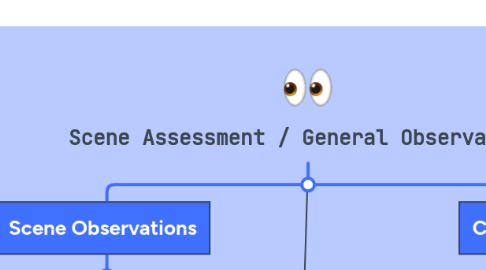
1. Scene Assessment / General Observations
1.1. Scene Observations
1.1.1. Location
1.1.1.1. Private Residence
1.1.1.2. Assisted Living
1.1.1.3. Skilled Nursing Facility
1.1.1.4. Urgent Care/Doctors Office
1.1.1.5. Large Public Spaces
1.1.1.6. Road/Street/Highways
1.1.2. Medical Devices
1.1.2.1. Wheelchair/Walkers
1.1.2.2. Dialysis Fistula
1.1.2.3. Continous Glucose Monitor & Insulin Pumps
1.1.2.4. Oxygen Concentrator
1.1.3. Communication
1.1.3.1. Language Barrier
1.1.3.2. Developmental Disorder
1.1.3.3. Cognitive Disorder
1.2. Cardinal Presentation
1.2.1. Patient positioning
1.2.1.1. Walking/Sitting/Lying
1.2.1.2. Tripod Position/Orthopnea
1.2.2. Activity/Movement
1.2.2.1. Acknowledges/Looks at you
1.2.2.2. Unilateral Extremity Movement
1.2.2.3. Slurred Speech
2. Secondary Assessment
2.1. Diagnostics
2.1.1. Vital Signs
2.1.1.1. Blood Pressure
2.1.1.2. Heart Rate
2.1.1.3. Respiratory Rate
2.1.1.4. Spo2
2.1.2. Diagnostic Tests
2.1.2.1. Blood Glucose
2.1.2.2. Temperature
2.1.2.3. 4 & 12 Lead EKG
2.1.2.4. ETco2
2.2. History Taking
2.2.1. SAMPLE
2.2.1.1. Signs/Symptoms
2.2.1.2. Allergies
2.2.1.2.1. Medications
2.2.1.2.2. Enviromental
2.2.1.3. Medications
2.2.1.3.1. "What medications are you taking?
2.2.1.3.2. "What medications are you prescribed?"
2.2.1.4. Past Medical History
2.2.1.4.1. "What medical problems have you been diagnosed with?"
2.2.1.5. Last Oral Intake
2.2.1.6. Events Leading Up
2.2.1.6.1. What the patient was doing prior to the incident
2.2.2. OPQRST
2.2.2.1. Onset
2.2.2.1.1. When and how the specific symptom began
2.2.2.1.2. Provocation
2.2.2.2. Quality
2.2.2.3. Radiation
2.2.2.4. Severity
2.2.2.5. Time
2.2.2.5.1. Duration and progression of the symptom
2.3. Physical Exam
2.3.1. Head
2.3.1.1. Pupils (Size, Reactivity)
2.3.1.2. Speech (Neuro)
2.3.1.3. Facial Palsy (Neuro)
2.3.2. Chest
2.3.2.1. Lung Sounds
2.3.3. Abdomen
2.3.4. Arms
2.3.4.1. Grip Strength (Neuro)
2.3.4.2. Arm Drift (Neuro)
2.3.5. Legs
2.3.6. Back
3. Change in patient condition?
4. Primary Assessment
4.1. Airway
4.1.1. Patency
4.1.1.1. Effortless Speech
4.1.1.2. Snoring
4.1.1.3. 2 - 3 word dyspnea
4.1.1.4. Obstructed
4.2. Breathing
4.2.1. Rate
4.2.1.1. Normal
4.2.1.2. Fast
4.2.1.3. Slow
4.2.1.4. Absent
4.2.2. Quality
4.2.2.1. Spontanous
4.2.2.2. Effortless
4.2.2.3. Labored
4.2.2.4. Shallow
4.3. Circulation
4.3.1. Pulse
4.3.1.1. Rate
4.3.1.1.1. Slow/normal/Fast
4.3.1.2. Rhythm
4.3.1.2.1. Regular/Irregular
4.3.1.3. Quality
4.3.1.3.1. Bounding/Weak/Absent
4.3.2. Skin Condition
4.3.2.1. Complexion (Pale, Cyanotic, Jaundice)
4.3.2.2. Warm/Cool/Hot
4.3.2.3. Dry/Clammy/Diaphoretic
4.4. Disability
4.4.1. Mental Status
4.4.1.1. Alert/Verbal/Pain/Unresponsive
4.4.1.2. Oriented/Confused
4.4.1.3. Is this the patients normal?