


Psychoanalitic Personalities Theories
por Fatimah Azzahra
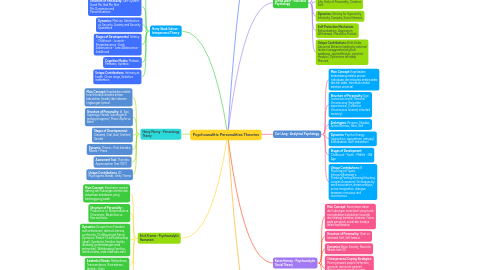
1. **Harry Stack Sulivan - Interpersonal Theory**
1.1. **Main Concept:** Kepribadian dibentuk dan dipertahankan melalui pola hubungan interpersonal dan kebutuhan akan keamanan.
1.2. **Structure of Personality:** Self-System: Good Me, Bad Me, Not Me. Dynamism and Personifications.
1.3. **Dynamics:** Motives: Satisfaction vs. Security. Anxiety and Security Operations
1.4. **Stages of Developmental**: Infancy - Childhood - Juvenile - Preadolescence - Early Adolescence - Late Adolescence - Adulthood
1.5. **Cognitive Modes:** Protaxic, Parataxic, Syntaxic.
1.6. **Unique Contributions:** Intimacy as health, Chum stage, Selective inattention.
2. **Henry Murray - Personology Theory**
2.1. **Main Concept:** Kepribadian adalah hasil interaksi dinamis antara kebutuhan (needs) dan tekanan lingkungan (press).
2.2. **Structure of Personality:** Id, Ego, Superego. Needs (viscreogenic and psychogenic), Press (Alpha vs. Beta)
2.3. **Stages of Developmental:** Claustral, Oral, Anal, Urethral, Genital
2.4. **Dynamic:** Thema = Pola Interaksi Needs + Press
2.5. **Assesment Tool:** Thematic Apperception Test (TAT)
2.6. **Unique Contributions:** 20 Psychogenis Needs, Unity Thema
3. **Erich Fromm - Psychoanalytic Humanism**
3.1. **Main Concept:** Kesehatan mental datang dari hubungan otentik dan aktualisasi kebebasan yang bertanggung jawab
3.2. **Structure of Personality:** Productive vs. Nonproductive Characters, Biophilous vs. Necrophilous
3.3. **Dynamics:** Escape from Freedom: authoritarianism, destructiveness, conformity. Childhood and Family Dynamics: Parent-Child Relationship (ideal), Symbiotic Families (terlalu dikekang, perkembangan anak terhambat), Withdrawing Families (terlalu bebas, anak tidak ada arah).
3.4. **Existential Needs:** Relatedness, Transcendence, Rootedness, Identity, Unity
3.5. **Unique Contributions:** Humanistic Communitarian Socialism, Mature Freedoom = freedom + love + responsibility
4. **Sigmund Freud - Psychoanalitic Theory**
4.1. **Main Concepts** : Perilaku didorong oleh konflik bawah sadar antara id, ego, dan superego.
4.2. **Structure of Personality** : Id (pleasure principle), Ego (reality principle), dan Superego (morality).
4.3. **Dynamics **: Anxiety (kecemasan), Defense Mechanism: Repression, Projection, Displacement, Rationalization, Denial, Regression, Reaction Formation.
4.4. **Stages of Development;** Psychosexual Stages of Development: 1. Oral Stage (0-18 month), 2. Anal Stage (18-36 month), 3.Phalic Stage (3-6 y.o), 4. Latency Stage (6-11 y.o), 4. Genital Stage (12+ y.o)
4.5. **Unique Contributions:** Unconscious mind, Dream Analysis, Free Association.
5. **Alfred Adler - Individual Psychology**
5.1. **Main Concept:** Manusia termotivasi untuk mengatasi inferioritas dan mencapai keunggulan pribadi melalui interaksi sosial.
5.1.1. Striving for Superiority
5.1.2. Subjective Perceptions
5.1.3. Unity of Personality
5.1.4. Social Interest
5.1.5. Style of Life
5.1.6. Creative Power