

GEOLOGICAL ORE DEPOSITS.
por nesmarly rivas
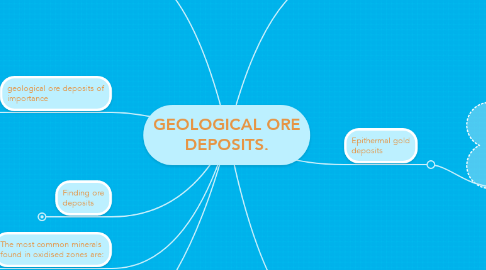
1. Many factors control the economic viability of an ore deposit but the most important are:
1.1. grade, size of the deposi, current price for the commodity, demand
2. geological ore deposits of importance
2.1. • metallic deposits • non-metallic deposits • fossil fuel deposits
2.1.1. Project specifications
2.1.2. End User requirements
2.1.3. Action points sign-off
3. Finding ore deposits
3.1. Project Sponsor
3.2. Project Manager
3.3. Developers
3.4. Primary User Group
3.5. Supporting Staff
4. The most common minerals found in oxidised zones are:
5. Copper, Lead, Nickel, Silver, Zinc
5.1. Schedule
5.2. Budget
5.3. Resources
5.4. Delays
6. Classification and types of mineral deposits
6.1. • commodity being mined • tectonic setting in which the deposit occurs • geological setting of the mineral deposit • genetic model for the origin of the ore deposit
7. Epithermal gold deposits
7.1. The main ore minerals are: • native gold and silver • electrum • acanthite and tetrahedrite • silica occurring as quartz (most often forming comb-like aggregates), amethyst, opal, chalcedony and cristobalite
8. other deposits
8.1. Placer deposits, Clay deposits, Evaporite deposits, Phosphatic deposits, Organic deposits, Residual deposits
8.1.1. KPI's