

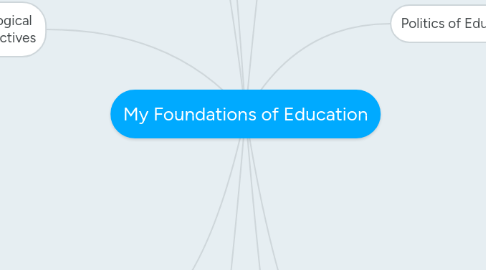
1. Sociological Perspectives
1.1. believes educators cant understand how all schools operate or they do what they do in the schools.
1.2. Schools is what helps shape children and their view of the world by processes of socialization.
1.3. The students knowledge and attitudes is a big part in the schools because if you don't have good knowledge and attitudes then the learning atmosphere is not good
1.4. We expect schools to teach students about social growth and shaping their learning
1.5. The Teachers behavior has a huge impact on student's learning and behavior.
1.6. Hopper made a statement that there is a difference between educational amount and educational route.
2. Philosophy of Education
2.1. Generic Notations
2.1.1. Plato argues for centrality of ideas.
2.1.2. Aristotle believed that through studying would it possible for us to develop ideas.
2.2. Key Researchers
2.2.1. Thomas Aquinas, Francis Bacon, John Locke, Alfred North Whitehead, and Bertrand Russell
2.3. Goal of Education
2.3.1. Pragmatism Visions of schools were rooted in the social order.
2.3.2. Teachers would be the basic academic disciplines in order to transmit their students to the knowledge for the human race.
2.4. Role of Teacher
2.4.1. The teachers responsibilty to use different ideas with students so they can travel to new levels of awareness that can be used.
2.4.2. The teacher no longer has authority over anything according to the progressive setting.
2.5. Method of Instruction
2.5.1. The Idealist teachers can be active in their classroom s.
2.5.2. Realists would support a number of different teaching techniques. Mostly they would lecture.
2.6. Curriculum
2.6.1. Idealists believe they could be more understood from the past.
2.6.2. Realists believe in the basic subjects such as science, math, reading, and writing.
2.6.3. Existentialists and phenomenologists would choose a plan that would be more towards the humanities.
3. Curriculum and Pedagogy
3.1. Social efficiency curriculm is an approach that developed of public secondary education.
3.2. The developmentalist curriculum is known of knowing the students than the needs of their society.
3.3. The politics of curriculum is known to analyze the struggles over different cenceptions.
3.4. Sociology of the curriculum focuses on not only what is being taught but the reasoning is being taught.
3.5. The mimic tradition is based on the viewpoint of the reasoning of education is to transmit knowledge to students.
3.6. The transformative tradition is based on different set of assumptions.
4. Equality of Opportunity
4.1. Society is known to be stratified. There are rich, poor, and people who are in the middle of those two.
4.2. The Coleman Study- this sociologist received a huge grand to work toward the characteristics of schools and their achievements.
4.3. This grant was meant to demonstrate the African American & white students have fundamental experience in their schools.
4.4. The past 30 years it is known that the upper middle classes in the US have become highly wealthy while others have incountered a decrease in their security income.
4.5. Today females are known to drop out of schools than males,but may have a higher level on their reading schools.
4.6. An individuals race has a impact on how much he or she is likely to achieve.
5. Educational Inequality
5.1. Functionalists believes the role of the schools are to give a fair selection for sorting out the best to the brightest.
5.2. Conflict theorists believes the role of schools should reproduce than be eliminated.
5.3. Cultural difference theorists believes there are differences between working class, non & white students and middle class.
5.4. One characteristic for the effective school literature is strong & effective leadership by a principle or school head.
5.5. Public schools are known to be fianced through a combination of revenues from local, state, & federal sources.
5.6. Biological explanations of human behavior is known as limited because scientists believe the social factors are responsible.
6. Politics of Education
6.1. Radical Perspective
6.1.1. Contrast to both the Conservative and Liberal Perspective.
6.1.2. Believes the capitalists system is ruled by the U.S. social problems.
6.1.3. Believes Social Problems are structural nature
6.1.4. Agrees with the liberal programs that are aimed at concerning equity.
6.1.5. Believes capitalism is the best economic system
6.1.6. They favor a movement toward the democratic side.
6.2. Taditional
6.2.1. Known as the most general representations view in the education field.
6.2.2. Views the schools of their traditional values such as their hard work, family unity, and individual initiative.
6.2.3. Believes schools should pass on the schools best.
6.2.4. Believes visions encompass from the right liberal to the conservative spectrums
6.2.5. Tend to view as non central to solving social problems
6.2.6. is between Liberal and Conservative
7. History of U.S. Education
7.1. The Traditional reform was a good influence because it wants schools to show their best.
7.2. GI Bill is noticed for "the most ambitious venture in mass higher education that has ever been attempted by any society"
7.3. The Brown decision provided the legal foundation for equality
7.4. Democratic Liberal School is committed to providing equality of opportunities of all students.
7.5. May 17, 1954 The Supreme Court ruled the state-imposed segregation of schools was unconstitutional.
7.6. Progressive reformers insisted on the government regulations are important.
8. Schools of Organizations
8.1. Senators
8.1.1. Richard Shelby
8.1.2. Jefferson Sessions
8.2. State Senator
8.2.1. Steve Livingston
8.3. House of Represenatives
8.3.1. Speaker of the House
8.3.1.1. Mike Hubbard
8.3.2. Speaker Pro Tempore
8.3.2.1. Victor Gaston
8.3.3. Clerk of The House
8.3.3.1. Jeffery Woodard
8.4. State Superintented
8.4.1. Tommy Bice
8.5. Local Superintented
8.5.1. Jason Barnett
8.6. Local School Board
8.6.1. Chairman
8.6.1.1. Matt Sharp
8.6.2. Vice Chairman
8.6.2.1. Jeff Williams
8.6.2.2. Randy Peppers
8.6.2.3. Mark Richards
8.6.2.4. Terry Wooten