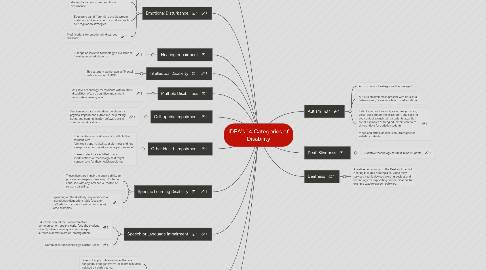
IDEA's 14 Categories of Disabilitypor Duncan Hubbs
1. Developmental Delay
1.1. Teachers must carefully scaffold instruction for developmentally delayed students, developing their cognitive skills as well as making time to work on motor, spatial, emotional and social skills. Instruction should support adaptive skills, or appropriate skills for everyday living.
1.2. Modifications for developmentally delayed students:
2. Emotional Disturbance
2.1. Schizophrenia is included under this category.
2.2. Social Difficulties are not included, unless the student has a concurrent emotional disturbance.
2.3. Educators can differentiate the classroom. materials, and assessment, as well as teach self-regulation strategies.
2.4. Modifications for emotionally disturbed students:
3. Hearing Impairment
3.1. A range of assistive technology is available to hearing impaired students:
4. Intellectual Disability
4.1. This category was known as "Mental Retardation" until 2010.
5. Multiple Disablilities
5.1. Assistive technology for students with multiple disabilities, often a cognitive impairment alongside a sensory one:
6. Orthopedic Impairment
6.1. Teachers must accommodate the student's physical impairment. Extra time, help taking notes, and communication software are all common modifications:
7. Other Health Impairment
7.1. This can be any condition which afflicts the student with "Limited strength, vitality, or alertness and has a negative effect on educational performance." These students are entitled to any modifications or technology that might compensate for their health problems.
8. Specific Learning Disability
8.1. These disorders impair the brain's ability to process language in some way. Not to be confused with any intellectual, motor, or sensory disability.
8.2. Depending on the disability, any modification that reduces distractions, aids focus, or scaffolds instruction should be considered. Some examples:
9. Speech or Language Impairment
9.1. Educators should focus on interactive communication, speak clearly, face the student directly when speaking, and encourage authentic communication, among others:
9.2. Communication technology is often used:
10. Traumatic Brain Injury
10.1. Does not apply to brain injuries that are congenital or degenerative, or to brain injuries induced by birth trauma.
10.2. Brain injury often harms basic cognitive abilities such as memory, learning, attention and concentration, word finding, and visual perception. Injury can also harm important academic abilities such as reading, arithmetic reasoning, vocabulary, writing, and spelling.
10.3. Accommodations for students with a TBI:
11. Visual Impairment Including Blindness
12. Autism
12.1. Autism cannot be diagnosed before age 3.
12.2. Autistic children often present with ritualistic behavior and/or are sensitive to certain stimuli.
12.3. Establishing routine and procedure, providing visual cues around the classroom, and seeking eye contact to maintain a students attention are all examples of thing educators can do to differentiate for autistic students. Video and article on Inclusion Strategies for autistic students::
13. Deaf-Blindness
13.1. Assistive technology for deaf-blind students
14. Deafness
14.1. Assistive technology for the Deaf and Hard of Hearing includes Hearing aids, video relay services, tactile devices, alerting devices and technology for supporting communication, for example text-to-speech software.