

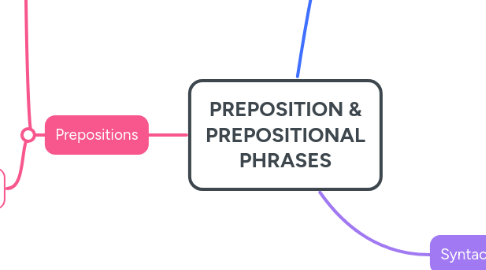
1. Prepositions
1.1. Definition
1.1.1. words used with nouns or noun equivalents to show the relation in which these nouns strand to some other words in the sentences.
1.2. Classification
1.2.1. According to Mophology
1.2.1.1. Simple prepositions
1.2.1.1.1. Most of prepositions in English are simple.
1.2.1.2. Compound prepositions
1.2.1.2.1. consist of two or more root morphemes.
1.2.1.3. Derived prepositions
1.2.1.3.1. considering, during, concerning, including, excluding, following,….
1.2.1.4. Composite prepositions
1.2.1.4.1. By virtue of, by mean of,according to, in regard to, in respect to, as well as, in spite of, because of, instead of, in addition to, out of, in front of,…
1.2.2. According to Semantics
1.2.2.1. Prepositions with a specific meaning
1.2.2.1.1. 1 - Prepositions of time
1.2.2.1.2. 2 - Prepositions of place or direction
1.2.2.1.3. 3 - Prepositions of purpose
1.2.2.1.4. 4 - Prepositions of similarity
1.2.2.1.5. 5 - Preposition of cause and reason
1.2.2.1.6. 6 - Preposition of manner
1.2.2.1.7. 7 - Preposition of mean
1.2.2.1.8. 8 - Preposition of relation
1.2.2.1.9. 9 - Preposition of measure
1.2.2.1.10. 10 - Preposition of direction
1.2.2.1.11. 11 - Preposition of agent
1.2.2.2. Prepositions without a specific meaning
1.2.2.2.1. attached to particular verbs, adjectives or nouns
2. Prepositional phrases (PPs)
2.1. consists of a preposition followed by a prepositional complement, which is characteristically a NP, an AdvP, a Wh-clause or a V-ing clause.
2.1.1. prep + NP: at bus-stop
2.1.2. prep + AdvP: from here
2.1.3. prep + a Wh-clause: about what he said
2.1.4. prep + V-ing clause: by signing a peace treaty
3. Syntactic funtions of PPs
3.1. Adverbial
3.1.1. Adjunct
3.1.1.1. a part of the basic structure of the clause or sentence in which it occurs, and modifies the verb (ex: adverbs of time, place, frequency, degree, and manner, ...)
3.1.1.1.1. he will do everything for money.
3.1.2. Disjunct
3.1.2.1. adverbs which show the speaker’s attitude to or evaluation of what is said in the rest of the sentence
3.1.2.1.1. in my opinion, he is quite a good man.
3.1.3. Conjunct
3.1.3.1. shows how what is said in the sentence containing the conjunct connects with what is said in another sentence or sentences
3.1.3.1.1. in short, he couldn't do it.
3.2. Modifier in a NP
3.2.1. pre-modifier(s) + head (a noun) + post-modifier(s) (modifier(s): dependent word(s))
3.2.1.1. very colourful desk in my office
3.2.2. pre-modifier(s) + head
3.2.2.1. on the desk
3.2.3. head + post-modifier(s)
3.2.3.1. the desk in my office
3.3. Complementation
3.3.1. Complementation of a verb
3.3.1.1. a word, phrase, or clause that follows the verb to add more information.
3.3.1.1.1. He’s lecturing on a new techniques of management.
3.3.2. Complementation of an adjective
3.3.2.1. a clause or phrase that gives information about an adjective or modifies it. It immediately follows an adjective in a sentence.
3.3.2.1.1. I’m sorry for coming late.