

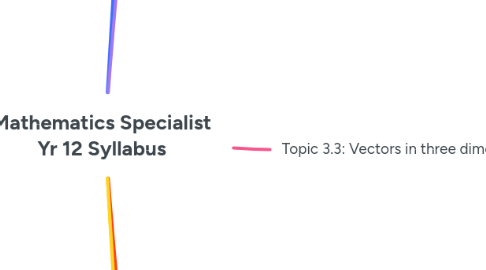
1. Topic 3.1: Complex numbers (18 hours)
1.1. Cartesian forms
1.1.1. 3.1.1 review real and imaginary parts Re(z) and Im(z) of a complex number z
1.1.2. 3.1.2 review Cartesian form
1.1.3. 3.1.3 review complex arithmetic using Cartesian forms
1.2. Complex arithmetic using polar form
1.2.1. 3.1.4 use the modulus |z| of a complex number z and the argument Arg (z) of a non-zero complex number z and prove basic identities involving modulus and argument
1.2.2. 3.1.5 convert between Cartesian and polar form
1.2.3. 3.1.6 define and use multiplication, division, and powers of complex numbers in polar form and the geometric interpretation of these
1.2.4. 3.1.7 prove and use De Moivre’s theorem for integral powers
1.3. The complex plane (The Argand plane)
1.3.1. 3.1.8 examine and use addition of complex numbers as vector addition in the complex plane
1.3.2. 3.1.9 examine and use multiplication as a linear transformation in the complex plane
1.3.3. 3.1.10 identify subsets of the complex plane determined by relations such as
1.3.3.1. d
1.4. Roots of complex numbers
1.4.1. 3.1.11 determine and examine the nth roots of unity and their location on the unit circle
1.4.2. 3.1.12 determine and examine the nth roots of complex numbers and their location in the complex plane
1.5. Factorisation of polynomials
1.5.1. 3.1.13 prove and apply the factor theorem and the remainder theorem for polynomials
1.5.2. 3.1.14 consider conjugate roots for polynomials with real coefficients
1.5.3. 3.1.15 solve simple polynomial equations
2. Topic 3.2: Functions and sketching graphs (16 hours)
2.1. Functions
2.1.1. 3.2.1 determine when the composition of two functions is defined
2.1.2. 3.2.2 determine the composition of two functions
2.1.3. 3.2.3 determine if a function is one-to-one
2.1.4. 3.2.4 find the inverse function of a one-to-one function
2.1.5. 3.2.5 examine the reflection property of the graphs of a function and its inverse
2.2. Sketching graphs
2.2.1. 3.2.6 use and apply |x| for the absolute value of the real number x and the graph of y = |x|
2.2.2. 3.2.7 examine the relationship between the graph of and the graphs of y = f(x) and the graphs of y = 1/f(x) , y = |f(x)| and y = f(|x|)
2.2.3. 3.2.8 sketch the graphs of simple rational functions where the numerator and denominator are polynomials of low degree
3. Topic 3.3: Vectors in three dimensions (21 hours)
3.1. The algebra of vectors in three dimensions
3.1.1. 3.3.1 define the concept of a vector in three dimensions, using the unit vectors i, j and k, determining magnitude, scalar (dot) product and parallel and perpendicular vectors
3.1.2. 3.3.2 prove geometric results in the plane and construct simple proofs in 3 dimensions
3.2. Vector and Cartesian equations
3.2.1. 3.3.3 introduce Cartesian coordinates for three dimensional space, including plotting points and equations of spheres
3.2.2. 3.3.4 use vector equations of curves in two or three dimensions involving a parameter and determine a ‘corresponding’ Cartesian equation in the two-dimensional case
3.2.3. 3.3.5 determine a vector equation of a straight line and straight line segment, given the position of two points or equivalent information, in both two and three dimensions
3.2.4. 3.3.6 examine the position of two particles, each described as a vector function of time, and determine if their paths cross or if the particles meet
3.2.5. 3.3.7 use the cross product to determine a vector normal to a given plane
3.2.6. 3.3.8 determine vector and Cartesian equations of a plane
3.3. Systems of linear equations
3.3.1. 3.3.9 recognise the general form of a system of linear equations in several variables, and use elementary techniques of elimination to solve a system of linear equations
3.3.2. 3.3.10 examine the three cases for solutions of systems of equations – a unique solution, no solution, and infinitely many solutions – and the geometric interpretation of a solution of a system of equations with three variables
3.4. Vector calculus
3.4.1. 3.3.11 consider position vectors as a function of time
3.4.2. 3.3.12 derive the Cartesian equation of a path given as a vector equation in two dimensions, including ellipses and hyperbolas
3.4.3. 3.3.13 differentiate and integrate a vector function with respect to time
3.4.4. 3.3.14 determine equations of motion of a particle travelling in a straight line with both constant and variable acceleration
3.4.5. 3.3.15 apply vector calculus to motion in a plane, including projectile and circular motion
4. Topic 4.1: Integration and applications of integration (20 hours)
4.1. Integration techniques
4.1.1. 4.1.1 integrate using the trigonometric identities
4.1.2. 4.1.2 use substitution u = g(x) to integrate expressions of the form
4.1.3. 4.1.3 establish and use the formula
4.1.4. 4.1.4 use partial fractions where necessary for integration in simple cases
4.2. Applications of integral calculus
4.2.1. 4.1.5 calculate areas between curves defined by functions of the form y=f(x) or x=f(y)
4.2.2. 4.1.6 determine volumes of solids of revolution about either axis
4.2.3. 4.1.7 use technology to evaluate integrals numerically
5. Topic 4.2: Rates of change and differential equations (20 hours)
5.1. Applications of differentiation
5.1.1. 4.2.1 use implicit differentiation to determine the gradient of curves whose equations are given in implicit form
5.1.2. 4.2.2 examine related rates as instances of the chain rule:
5.1.3. 4.2.3 apply the increments formula δy≈dy/dx δx to differential equations
5.1.4. 4.2.4 solve simple first order differential equations of the form ; differential equations of the form ; and, in general, differential equations of the form , using separation of variables
5.1.5. 4.2.5 examine slope (direction or gradient) fields of a first order differential equation
5.1.6. 4.2.6 formulate differential equations, including the logistic equation that will arise in, for example, chemistry, biology and economics, in situations where rates are involved
5.2. Modelling motion
5.2.1. 4.2.7 consider and solve problems involving motion in a straight line with both constant and non-constant acceleration, including simple harmonic motion and the use of expressions , for acceleration
6. Topic 4.3: Statistical inference (15 hours)
6.1. Sample means
6.1.1. 4.3.1 examine the concept of the sample mean as a random variable whose value varies between samples where is a random variable with mean and the standard deviation
6.1.2. 4.3.2 simulate repeated random sampling, from a variety of distributions and a range of sample sizes, to illustrate properties of the distribution of across samples of a fixed size n , including its mean its standard deviation (where and are the mean and standard deviation of X ), and its approximate normality if n is large
6.1.3. 4.3.3 simulate repeated random sampling, from a variety of distributions and a range of sample sizes, to illustrate the approximate standard normality of for large samples , where s is the sample standard deviation
6.2. Confidence intervals for means
6.2.1. 4.3.4 examine the concept of an interval estimate for a parameter associated with a random variable
6.2.2. 4.3.5 examine the approximate confidence interval as an interval estimate for the population mean , where z is the appropriate quantile for the standard normal distribution
6.2.3. 4.3.6 use simulation to illustrate variations in confidence intervals between samples and to show that most but not all confidence intervals contain
6.2.4. 4.3.7 use to estimate to obtain approximate intervals covering desired proportions of values of a normal random variable, and compare with an approximate confidence interval for