


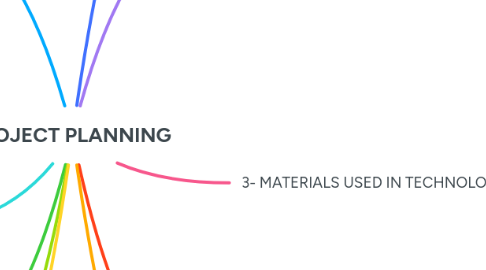
1. 6-WORKHOP
1.1. ORGANISATION (It's important to know where we should use and keep tools and where we should a sent iobs)
1.2. THE CLASSROOM AND THE COMPUTER ROOM (are where we have theoretical classes, search for infermation, do research)
1.3. DOCUMENTS (are kept in an area where they can be consulted during a project)
1.4. TOOLS (are usually located on panels, with a different colour for each group, or in boxes that are numbered for each table)
1.5. MATERIALS (are kept in a storage room and taken out when needed)
1.6. PROJECTS ( are organised on shelves by class and by group so that everything can be easily located)
1.7. WORK GROUPS ( groups. Although students sometimes work individually or in pairs, most technological activities are done in groups)
1.8. ROLES ( Working in groups is more efficient when each member of the group accepts responsibility for a certain role, such as coordination)
2. 7-BUSINESSES
2.1. .
2.1.1. MANAGEMENT: This includes functions related to Ul: business's objectives and how they're achieved. The management team makes strategic decisions and other departments put these into practice.
2.1.2. PRODYUCTION: iludes all activities related to preducing goods: purchasing raw materials, the production process, the overall organisation and management of those activities.
2.1.3. LOGISTIC: The objective is to get the product to the customer in the best way possible. This includes various tasks, such as advertising, transport, distribution and after-sales service.
3. 8-HOW TECHNOLOGY INFLUENCES SOCIETY
3.1. The transition from one model of society to another has always happened because human beings developed new technologies. This could
3.1.1. SOCIETY TYPE AND CHARACTERISTICS
3.1.2. TECHNOLOGIA INNOVATION
4. 9- THE ENVIROMENMENTAL IMPACT OF TECHNOLOGY
4.1. Technological develop understand those pro! technological process wen cause environmental problems. To understand those problems, we need to analyse two important stages in the techonological process:
4.1.1. ANALYSIS OF THE NERD OR PROBLEM: Is the need or problem real? Or is it the result of advertising or manipulation by individuals or groups? Do you think people are happier and live better now than in the past?
5. PRODUCT TESTING AND FVALUATION: Have we done a critical analysis of the technological solution? Or have we prioritised economic factors over social and environmental factors? Who's responsible for this?
6. 1-WHATS TECNOLOGY
6.1. Materials, Scientific and technical knowlge and concepts, Technical drawings, Computers, Tecnical skills, Economic factors
7. 2-STAGES OF TECHNOLOGICAL PROYECTS
7.1. NEEDS ( Carey out needs analysis and work out what the issues might be)
7.2. IDEAS ( Write individual proposals, present the proposals to the group and vote no them)
7.3. DEVELOP THE IDEAS ( Make technical drawing, créate a bubget,present a construction plan)
7.4. CONSTRUTION ( Construct the solution)
7.5. VERIFICATION ( Check the solution, write a summary report)
7.6. MARKETING ( Market launch and sales to the public)
8. 3- MATERIALS USED IN TECHNOLOGY AND ENVIRONMENT IMPACT
8.1. MATERIAL: Wood ORIGIN: obtained from trees USES: furniture pulp and papee industry. TIPOS: hardwood, softwood, derived products.
8.2. MATERIAL: Metals and alloys ORIGIN: extracted from minerals in rocks. USES: machine chassis and parts, tools, electronic component, screw TIPOS: Ferrous and non-ferrous
8.3. MATERIAL: Textiles ORIGIN: made from plant, animal and mineral raw materials. USES: in the form of threads, to make fabrics with clothes and carpets TIPOS: natural and sythetic
8.4. MATERIAL: Stone ORIGIN: take from rocks in various sizes, from large blocks to finesand USES: constrution materials and decorative features TIPOS: pure and mixed
8.4.1. MATERIAL: Platics ORIGIN: made from oil,coal, natural gas and animal protein USES: pipes, packaging, toys, containers, wire coatings TIPOS: natural and sythetic
8.5. MATERIAL: Ceramics ORIGIN: Made by moulding clay then baking it at a high temperatur USES: construction materials such bricks and tiles crockery TIPOS: thick ceramics and fine ceranucs
9. 4- TOOLS US USED IN TECHNOLOGY
9.1. DRAWING TOOLS
9.2. PHYSICAL TOOLS
9.3. DIGITAL TOOLS
9.4. ADVANCED MANUFACTURING TOOLS
10. 5- DIGITAL MANUFACTURING: ( In digital manufacturing, 3D objects are designed on a computer using CAD programs, such as Tinkercad, SolidWorks, FreeCAD, OpenSCAD and AutoDesk.
10.1. 5.1-TYPES OF 3D PRINTER: ( 3D printing is an additive process. In other words, 3D printers deposit a material layer by layer until the object is complete. There are three main types:Fused deposition modelling FDM, stereolithography, selective láser sintering( SLS)
10.1.1. 5.2- COMPUTER NUMERICAL CONTROL MACHINES: CNC machines cut a block or sheet of material into the required shape following instructions from a computer program. The most common are cutting, drilling or milling machines.