

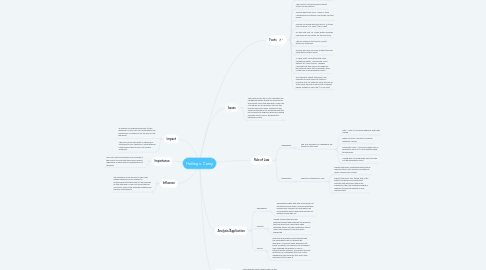
1. Impact
1.1. In addition to holding physicians to the standard of care, this case emphasizes the importance of prudence on the part of the physician.
1.2. The case could also result in physicians resorting to over-testing i.e. administering unnecessary tests to rule out unlikely diagnosis.
2. Importance
2.1. This case sets a precedence for equality in the quality of care that individuals receive regardless of their age or predisposition to diseases.
3. Influence
3.1. The supreme court decision in this case makes physicians more vigilant in determining tests that may not be required by the standard of care but administering such tests could save both the patients and medical practitioners.
4. Facts
4.1. Barbara Helling (Plaintiff) consulted with Ophthalmologists Carey and Laughlin for Myopia in 1959.
4.2. The Doctors recommended contact lenses for the patient
4.3. Helling went back to Dr. Carey in 1963 complaining of irritation due to the contact lenses.
4.4. Helling consulted with the doctor 10 times over a period of 5 years (1963-1968).
4.5. On the 10th visit, Dr. Carey tested Helling's eye pressure and vision for the first time.
4.6. The eye pressure test led to correct glaucoma diagnosis.
4.7. Helling, who was 32 years at that time had essentially lost her vision.
4.8. In 1969, after consulting with other ophthalmologists, Helling filed a suit against Dr. Carey and Dr. Laughlin claiming that their failure to diagnose her glaucoma was the proximate cause of the loss of her peripheral vision.
4.9. According to expert testimony, the standard of care does not require a pressure test for patients under the age of forty since the risk of glaucoma in people below 40years is very low (1 in 25,000).
5. Issues
5.1. The issue before the court is whether the ophthalmologists should be absorbed of any liability since the standard of care did not require an eye pressure test for the plaintiff who was under 40years of age even though failure to administer the test led to failure to diagnose glaucoma which probably led to loss of the plaintiff's peripheral vision.
6. Rule of Law
6.1. Negligence
6.1.1. The four elements of negligence are present in this case.
6.1.1.1. Duty - Duty to correctly diagnose and treat Helling
6.1.1.2. Breach of Duty: Failure to correctly diagnose Helling
6.1.1.3. Proximate cause - Glaucoma leads loss of peripheral vision if it is not detected and treated early.
6.1.1.4. Helling was not diagnosed early and she lost her peripheral vision.
6.2. Malpractice
6.2.1. Breach of standard of care
6.2.1.1. Expert testimony established that routine pressure test is not required for patients under 40years like Helling
6.2.1.2. Expert testimony also stated that if the patient complains and symptoms indicate that glaucoma should be suspected, then the ophthalmologist is required to give the patient an eye pressure test.
7. Analysis/Application
7.1. Defendants
7.1.1. Defendants argue that they are should not be liable because they complied with their professional standard of care which did not mandate routine eye pressure test for patients below age 40
7.2. Plaintiff
7.2.1. Helling claimed that had the ophthalmologist administered the pressure test, her glaucoma could have been detected earlier and the substantial loss of vision she suffered could have been prevented
7.3. Courts
7.3.1. Both trial and appeal courts argued that the defendants did not breach the standard of care and were therefore not liable. However, the supreme court argued that although the disease is rare in patients below 40years, the benefit of early detection far outweighs the cost of the inexpensive eye pressure test and it was imprudent not to give it.