

1. 1. Paper
1.1. 1.2. PaperID
1.2. 1.3. Paper title
1.3. 1.4. Theoretical Foundation
2. 2. Company Information
2.1. 2.1. Name
2.2. 2.2. Company Domicile
2.3. 2.3. Industry
2.4. 2.4. Foundation Year
2.5. 2.5. Employees before DT
2.6. 2.6. Employees Now
2.7. 2.7. Financial Situation
2.7.1. 2.7.1. Financial Situation
2.7.2. 2.7.2. D/E Ratio
2.7.3. 2.7.3. EBITDA
2.7.4. 2.7.4. Liquidity (Cash Ratio)
2.8. 2.8. Sales Relationship (B2B/B2C/B2G)
3. 3. Market Situation
3.1. 3.1. Before
3.1.1. 3.1.1. Industry Rivalry
3.1.2. 3.1.2. Bargaining power of buyers
3.1.3. 3.1.3. Bargaining power of suppliers
3.1.4. 3.1.4. Threat of new entrants
3.1.5. 3.1.5. Threat of substitutes
3.2. 3.2. After
3.2.1. 3.2.1. Industry Rivalry
3.2.2. 3.2.2. Bargaining power of buyers
3.2.3. 3.2.3. Bargaining power of suppliers
3.2.4. 3.2.4. Threat of new entrants
3.2.5. 3.2.5. Threat of substitutes
4. 4. Meta Information
4.1. 4.1. Triggers
4.1.1. 4.1.1. Internal
4.1.1.1. 4.1.1.1. Organizational
4.1.1.2. 4.1.1.2. Technical
4.1.1.3. 4.1.1.3. Economical
4.1.2. 4.1.2. External (Push)
4.1.2.1. 4.1.2.1. Technical
4.1.2.2. 4.1.2.2. Regulatory
4.1.3. 4.1.3. External (Pull)
4.1.3.1. 4.1.3.1. Technical
4.1.3.2. 4.1.3.2. Organizational
4.2. 4.2. DT Strategy
4.2.1. 4.2.1. Initiation Year of DT Strategy
4.2.2. 4.2.2. DT Attempts Before
4.2.2.1. 4.2.2.1. Holistic DT Strategy
4.2.2.2. 4.2.2.2. #Attempts
4.2.3. 4.2.3. Information about existing DT Attempts
4.3. 4.3. DT Budget
4.4. 4.4. DT Drivers
4.5. 4.5. Scope
4.5.1. 4.5.1. Scope of Project
4.5.2. 4.5.2. Scope Defined?
4.6. 4.6. Change Agent
4.7. 4.7. Hierachy of DT Unit
4.8. 4.8. Responsible Unit
4.9. 4.9. External Agents
4.10. 4.10. KPIs for Measurement of DT
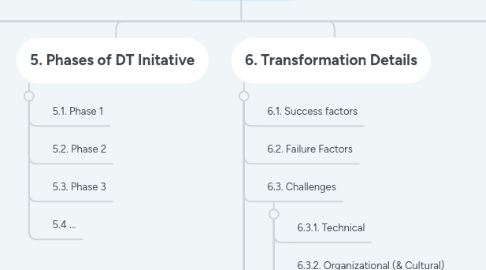
5. 5. Phases of DT Initative
5.1. 5.1. Phase 1
5.2. 5.2. Phase 2
5.3. 5.3. Phase 3
5.4. 5.4 ...
6. 6. Transformation Details
6.1. 6.1. Success factors
6.2. 6.2. Failure Factors
6.3. 6.3. Challenges
6.3.1. 6.3.1. Technical
6.3.2. 6.3.2. Organizational (& Cultural)
6.3.3. 6.3.3. Lack of Cross learning
6.3.4. 6.3.4. Other
6.3.5. 6.3.5. Communication
6.3.6. 6.3.6. Sales
6.3.7. 6.3.7. Dependencies
6.4. 6.4. Reasons for Resistance within company
6.5. 6.5. Agency
6.5.1. 6.5.1. G-Agency (Centralized/Decentralized/Hybrid)
6.5.2. 6.5.2. W-Agency (Planned/Emergent/Hybrid)
6.6. 6.6. Technology Usage
6.6.1. 6.6.1. Type
6.6.1.1. 6.6.1.1. New Technology
6.6.1.2. 6.6.1.2. New Application of existing Technology
6.6.1.3. 6.6.1.3. Neither of Both
6.6.2. 6.6.2. Categorisation
6.7. 6.7. Change Management
6.7.1. 6.7.1. Type
6.7.1.1. 6.7.1.1. Top Down
6.7.1.2. 6.7.1.2. Bottom Up
6.7.1.3. 6.7.1.3. Contercurrent
6.7.2. 6.7.2. Change of Org. Structure
6.7.3. 6.7.3. Change of Org. Culture
6.7.4. 6.7.4. Change Mgmt Methods
6.8. 6.8. Lack of Cap. Internal
6.9. 6.9. Required Cap.
6.10. 6.10. Ambidextrie
6.10.1. 6.10.1. Exploitation
6.10.2. 6.10.2. Exploration
6.11. 6.11. Business Model Patterns
6.11.1. 6.11.1. BMP Before
6.11.2. 6.11.2. BMP After
6.12. 6.12. Cross Unit cooperation
6.13. 6.13. Platformization
6.13.1. 6.13.1. Investment platform
6.13.2. 6.13.2. Integrated platform
6.13.3. 6.13.3. Transactionplatform
6.13.4. 6.13.4. Innovationplatform
6.14. 6.14. Newly introduced working methods
6.15. 6.15. Vision, Mission & Strategy
6.15.1. 6.15.1. Defined?
6.15.2. 6.15.2. Communicated?
7. 7. Outcomes
7.1. 7.1. Planned Goals
7.1.1. 7.1.1. Reasons why not realized
7.2. 7.2. Archieved Goals
7.2.1. 7.2.1. Measures of Impacts