Unlock the full potential of your projects.
Try MeisterTask for free.
¿No tienes una cuenta?
Regístrate Gratis
Navegar
Mapas Destacados
Categorías
Gestión de proyectos
Objetivos de negocio
Recursos humanos
Lluvia de ideas y análisis
Marketing y contenido
Educación y notas
Entretenimento
Vida
Tecnología
Diseño
Resúmenes
Otros
Idiomas
English
Deutsch
Français
Español
Português
Nederlands
Dansk
Русский
日本語
Italiano
简体中文
한국어
Otros
Ver mapa completo
Copiar y editar mapa
Copiar
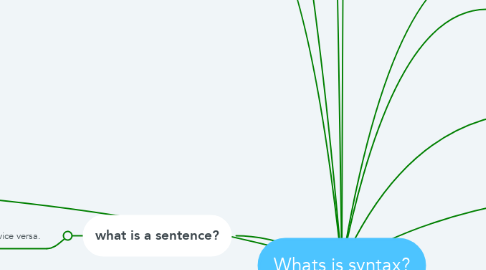
Whats is syntax?
Otros
NF
Nouf fahad almuhareb
Seguir
Comienza Ya.
Es Gratis
Regístrate con Google
ó
regístrate
con tu dirección de correo electrónico
Mapas Mentales Similares
Esbozo del Mapa Mental
Whats is syntax?
por
Nouf fahad almuhareb
1. Falsifiability (Predictions)
1.1. A hypothesis must make predictions.
1.2. To see whether a hypothesis is correct you look for the prediction that will prove the hypothesis wrong
1.3. If the piece of evidence that would prove the hypothesis wrong is true, then the hypothesis must be revised.
2. Rules a kind of hypothesis:
2.1. we will encode our hypotheses about sentence structure using rules
2.2. A grammar in the linguistic sense is a cognitive structure. It is the part of the mind that generates and understands language
2.3. A group of rules are called a Grammar
3. what is a sentence?
3.1. A hierarchically organized structure of words that maps sound to meaning and vice versa.
4. Syntactic judgments: concern the FORM of a sentence
5. Semantic judgments: are about the MEANING of a sentence
6. Acceptability Judgments
6.1. sometimes acceptability judgments are called intuitions.
6.2. sometimes acceptability judgments are called intuitions.
6.3. The term ‘intuition’ has a negative connotation: makes us think of fortune tellers and psychics
6.4. However, acceptability judgments are both experimentally valid and statistically sound
6.5. sometimes acceptability judgments are called intuitions.
6.6. The term ‘intuition’ has a negative connotation: makes us think of fortune tellers and psychics
6.7. However, acceptability judgments are both experimentally valid and statistically sound
7. Learning: involves conscious gaining of knowledge
7.1. Acquisition: involves subconscious gaining of knowledge
8. A shocking proposal: • Noam Chomsky
8.1. The ability of humans to use language is innate (an instinct). We are prewired to use language.
9. The scientific study of sentence structure
10. Evaluating grammars:
10.1. Observationally Adequate grammar
10.2. Descriptively Adequate
10.3. Explanatorily Adequate
11. Syntactic judgments: concern the FORM of a sentence
12. performance: refers to what we actually produce
12.1. competence: refers to what we know about language
13. Sources of data:
13.1. Collections of recorded real world speech
13.2. Telephone recordings (LDC)
13.3. Newspapers,Books, Magazines
13.4. Folk tales etc recorded in the field
13.5. The web
13.6. The web
14. The 3 arguments in support of the UG:
14.1. A) language is infinite despite the poverty of input , we produce sentence we have never heard before
14.2. B) we know things about our language that we have never been exposed to
14.3. C) you know things about your language that you have never been taught
15. Prescriptive rules: prescibe how we should speak
15.1. Descriptive rules: describe how we actually speak
Comienza Ya. ¡Es Gratis!
Conéctate con Google
ó
Regístrate