

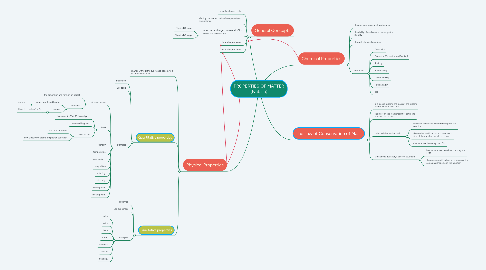
1. General Concepts
1.1. specific characteristic
1.2. identify the matter that makes up an object or substance
1.3. when matter changes, some or all of its properties may change
1.3.1. Physical Change
1.3.2. Chemical Change
1.4. intensive properties
1.5. extensive properties
2. Physical Properties
2.1. change without the substance becoming a different substance
2.2. Quantitative properties
2.2.1. measured
2.2.2. use tools
2.2.3. examples
2.2.3.1. size and shape
2.2.3.1.1. the dimension and form of an object
2.2.3.1.2. examples
2.2.3.2. mass
2.2.3.2.1. the amount of “stuff” in an object
2.2.3.2.2. measured in grams
2.2.3.2.3. depends on
2.2.3.3. density
2.2.3.4. temperature
2.2.3.5. conductivity
2.2.3.6. magnetism
2.2.3.7. solubility
2.2.3.8. viscosity
2.2.3.9. boiling Point
2.2.3.10. melting Point
2.3. Qualitative properties
2.3.1. observed
2.3.2. use our senses
2.3.3. examples
2.3.3.1. color
2.3.3.2. odor
2.3.3.3. taste
2.3.3.4. sound
2.3.3.5. hardness
2.3.3.6. texture
2.3.3.7. flexibility
3. The Law of Conservation of Mass
3.1. in a closed system, the mass of the system cannot change over time
3.2. the mass of the reactants must equal the mass of the products.
3.3. balanced chemical equation
3.3.1. shows all mass is conserved throughout the reaction
3.3.2. the number and kinds of atoms on each side of the equation should be equal
3.3.3. chemical reaction obey the LCM
3.4. unbalanced Equation/Skeleton Equations
3.4.1. he chemical reaction does not obey the LCM
3.4.2. the number and kinds of atoms are not the same on either side of the equation
4. Chemical Properties
4.1. the chemical makeup of a substance
4.2. the ability of a substance to change its identity
4.3. through chemical reactions
4.4. examples
4.4.1. Reactivity
4.4.2. Corrosion (Oxidation and Tarnish)
4.4.3. Toxicity
4.4.4. Flammability
4.4.5. Combustibility
4.4.6. Radioactivity
4.4.7. pH