


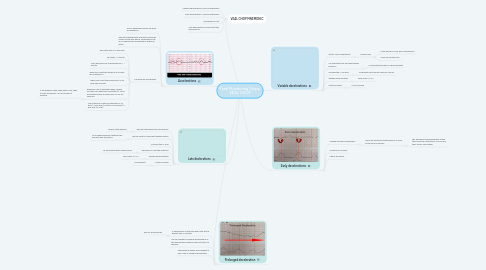
1. Accelerations
1.1. Are an expected finding. We want accelerations.
1.2. Indicate a healthy fetal-placental exchange. A sign of fetal well being. Accelerations go up, as opposed to decelerations which go down.
1.3. Counting an acceleration
1.3.1. Each little box is 10 seconds
1.3.2. Six boxes = 1 minute
1.3.3. From dark pink line to dark pink line = 1 minute
1.3.4. When you count the boxes up it is beats per minute BPM
1.3.5. When you count the boxes over it is for how may seconds
1.3.6. Example: if an acceleration goes 3 boxes up, that is 30 beats per minute(BPM). If the acceleration goes 3 boxes over it is for 30 seconds.
1.3.6.1. If the baseline Fetal Heart Rate is 130, then it must increase to 145 for at least 15 seconds
1.3.7. The criteria for a good acceleration is 15 BPM ( a box and 1/2 up) for 15 seconds ( a box and 1/2 over).
2. Late declerations
2.1. Indicate Uteroplacental Insufficiency
2.1.1. Risk for fetal hypoxia
2.2. Lay the client on the side/change position
2.2.1. To Increase perfusion between the placenta and the uterus
2.3. Increase the IV fluid
2.4. Decrease or Stop the Oxytocin
2.4.1. To decrease uterine tachysystole
2.5. Oxygen administration
2.5.1. Face mask 10-12 L
2.6. Notify Provider
2.6.1. If unresolved
3. Prolonged deceleration
3.1. A deceleration in the fetal heart rate that is greater than 2 minutes
3.1.1. Risk for fetal hypoxia
3.2. Can be caused by variable decelerations or late decelerations that just did not return to baseline.
3.3. Interventions based upon whether it was a late or variable deceleration
4. VEAL CHOP MNEMONIC
4.1. Variable decelerations=Cord Compression
4.2. Early deceleration= Head Compression
4.3. Accelerations=OK
4.4. Late decelerations=Placental/utero insufficiency
5. Variable decelerations
5.1. Due to cord compression
5.1.1. Nuchal cord
5.1.1.1. Fetus laying on cord and compresing it
5.1.1.2. Cord around the neck
5.2. Lay the patient on the side/change positions
5.2.1. All fours/hands knees is a good position
5.3. Increase the IV infusion
5.3.1. To hydrate and increase vascular volume
5.4. Oxygen administration
5.4.1. Face mask 10-12 L
5.5. Notify provider
5.5.1. If not resolved
6. Early decelerations
6.1. Caused by head compression
6.1.1. This is an expected finding when it is close to the time of delivery
6.1.1.1. The fetal heart rate decelerates at the same time the contraction is occurring, they "mirror" each other.