

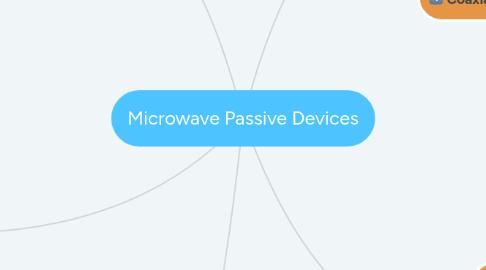
1. Phase Shifters
1.1. Applications
1.1.1. phase modulators
1.1.2. frequency up converters
1.1.3. testing instruments
1.1.4. phased array antennas
1.2. Advantages
1.2.1. increase transmission capacity
1.2.2. improve grid stability
1.2.3. cross network trading
1.3. Specifications
2. Waveguide Tees
2.1. Applications
2.1.1. To measure the impedence
2.1.2. Is used as a duplexer
2.1.3. Is used as a Mixer
2.1.4. used as Microwave Bridge
2.2. Advantages
2.2.1. it is small in size
2.2.2. It supports larger bandwidth
2.3. Specifications
3. Magic Tees
3.1. Applications
3.1.1. is used to measure the impedence
3.1.2. is used as a duplexer
3.1.3. is used as a mixer
3.2. Advantages
3.2.1. Output ports are decoupled to each other
3.2.2. it is small in size
3.2.3. it supports larger bandwidth
3.3. Specifications
3.3.1. frequency range(0.32-40 GHz)
3.3.2. Colinear Balance(+/-0.1dB)
3.3.3. Insertion Loss(<0.1dB)
3.3.4. E-H Isolation(30 dB minimum)
4. Coaxial Connectors and Adapters
4.1. Applications
4.1.1. transmission line for radio frequency signals
4.1.2. computer network connections
4.1.3. digital audio and distribution of cable television signals
4.2. Advantages
4.2.1. Coax supports high bandwidth levels
4.2.2. Coax is easy to install
4.2.3. Coax is easy to locate
4.2.4. Coax can provide power
4.3. Specifications
4.3.1. solid polyethylene-(1.54ns/ft)
4.3.2. foam polyethylene-(1.27ns/ft
4.3.3. solid teflon-(1.46ns/ft)
4.3.4. air space teflon-(1.13-1.20ns/ft)
5. Attenuators
5.1. Applications
5.1.1. volume control equipment in broadcasting stations
5.1.2. For testing purposes in laboratories
5.1.3. used to improve the impedence matching in circuits
5.2. Advantages
5.2.1. This allows for much faster switching speed
5.2.2. It offers higher power handling capacity
5.3. Specifications
5.3.1. Attenuation(dB)
5.3.2. Power dissipation(w)
5.3.3. Attenuator capability
5.3.4. VSBR