


PYP Learning
por Gillian O'Hara PYP Teacher
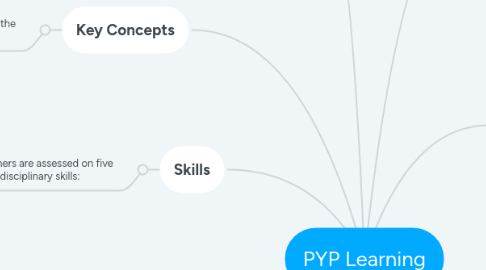
1. Transdisciplinary Themes
1.1. Who We Are Where We Are in Place and Time How We Express Ourselves How the World Works How We Organize Ourselves Sharing the Planet
2. Key Concepts
2.1. There are 8 key concepts that drive the inquiry and investigation:
2.1.1. Form - What is it like? Function - How does it work? Causation - Why is it like it is? Change - How is it changing? Connection - How is it connected to other things? Perspective – What are the points of view? Responsibility – What is our responsibility? Reflection – How do we know?
3. Skills
3.1. Learners are assessed on five transdisciplinary skills:
3.1.1. Thinking Skills Research Skills Self-Management Skills Communication Skills Social Skills
4. Communities of Learning
4.1. Teachers collaborate to ensure a holistic, transdisciplinary approach.
4.2. Experts can be brought in to provide real-world knowledge to learners.
4.3. Students with similar interests and ideas can collaborate on inquiries to assist each other in their learning.
4.4. Parents play a central role in not only encouraging their children but helping to set learning goals and monitor work.
5. Inquiry Learning
5.1. Learners discover their own voice as they ask questions, research, and report back on topics of their own choosing.
5.2. Allows students to follow their own curiosity within the larger concept.
6. Transdisciplinary
6.1. The PYP learning strategy encompasses all fields of learning for a holistic approach. Teachers of each subject collaborate, allowing students to see problems from every educational angle.
6.2. Transdisciplinary learning provides the learner with opportunities for student ownership, reflection, voice and choice.
7. Learner Profiles
7.1. There are 10 learner profiles exhibited by a PYP learner:
7.1.1. Inquirer Thinker Communicator Reflective Risk-Taker Knowledgeable Open-Minded Balanced Caring Principled