


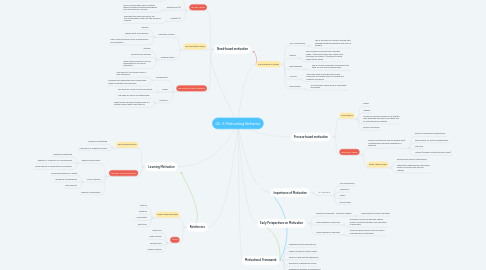
1. Reinforcers
1.1. Kinds of Reinforcement
1.1.1. Positive
1.1.2. Negative
1.1.3. Punishment
1.1.4. Extinction
1.2. Timing
1.2.1. Fixed-ratio
1.2.2. Fixed-interval
1.2.3. variable-ratio
1.2.4. variable-interval
2. Need-based motivation
2.1. The ERG Theory
2.1.1. Existence (E)
2.1.1.1. Those necessary for basic human survival/correspond with Physiological from the hierarchy of needs
2.1.2. Relatedness (R)
2.1.2.1. Those involving the need to relate to others/correspond with Belongingness from the hierarchy of needs
2.1.3. Growth (G)
2.1.3.1. Essentially the same premise as the Self-Actualization need from the hierarchy of needs
2.2. The Two Factor Theory
2.2.1. Motivation Factors
2.2.1.1. intrinsic
2.2.1.2. achievement & recognition
2.2.1.3. Often cited as primary cause of satisfaction and motivation
2.2.2. Hygiene factors
2.2.2.1. extrinsic
2.2.2.2. benefits & job security
2.2.2.3. Often cited as primary cause of dissatisfaction and lack of motivation
2.3. The Acquired Need Framework
2.3.1. Achievement
2.3.1.1. The desire to accomplish a goal or task effectively
2.3.1.2. achievers set moderately difficult goals and make moderately risky decisions
2.3.2. Power
2.3.2.1. The desire to control one's environment
2.3.3. Affiliation
2.3.3.1. The need for human companionship
2.3.3.2. These people are likely to believe and act as they believe others want them to
3. Learning Motivation
3.1. How Learning Occurs
3.1.1. Classical conditioning
3.1.2. Learning as a Cognitive Process
3.2. Learning- Based Perspectives
3.2.1. Reinforcment Theory
3.2.1.1. Operant conditioning
3.2.1.2. behavior is a function of consequences
3.2.1.3. reinforcement is consequence of behavior
3.2.2. Social Learning
3.2.2.1. observing behaviors of others
3.2.2.2. recognize consequences
3.2.2.3. alter behavior
3.2.3. Behavior Modification
4. The Hierarchy of Needs
4.1. Self-Actualization
4.1.1. This is the need of a person fulfilling their untapped potential whatever that may be to them.
4.2. Esteem
4.2.1. This is based off primarily two different needs: 1) the need to have self respect and a positive self image. 2) the need of being respected by others.
4.3. Belongingness
4.3.1. This is a social need that encompasses the need for love and companionship
4.4. Security
4.4.1. This is the need for things that provide protection and safety such as clothing and freedom from worry
4.5. Physiological
4.5.1. The most basic needs such as food water and shelter
5. Process-based motivation
5.1. Equity theory
5.1.1. equity
5.1.2. inequity
5.1.3. focuses on people's desires to be treated with what they perceive to be equity and to avoid perceived inequity
5.1.4. Equity comparison
5.2. Expectancy Theory
5.2.1. people motivated by how much they want something and perceived likelihood of getting it
5.2.1.1. effort-to-performance expectancy
5.2.1.2. Performance-to-outcome expectancy
5.2.1.3. Outcome
5.2.1.4. Valence (Degree of attractiveness/Value)
5.2.2. Porter-Lawler Model
5.2.2.1. performance leads to satisfactioin
5.2.2.2. satisfaction determined by perceived equity of intrinsic and extrinsic rewards
6. Importance of Motivation
6.1. P = M x A x E
6.1.1. Job Performance
6.1.2. Motivation
6.1.3. Ability
6.1.4. Environment
7. Motivational Framework
7.1. experiencing need deficiencies
7.2. Search for ways to satisfy needs
7.3. Choice of goal-directed behaviors
7.4. Enactment of Behavioral choice
7.5. Experienced Rewards or punishment
7.6. Reassessment of Need Deficiencies
8. Early Perspectives on Motivation
8.1. Traditional Approach - Scientific Method
8.1.1. employees are money motivated
8.2. Human Relations Approach
8.2.1. employee inclusion in decision making results in positive attitudes and motivation to work hard
8.3. Human Resource Approach
8.3.1. assumes people want to and are able to make genuine contributions