
The number of middle and high school students who score proficient or above on end-of-course math...


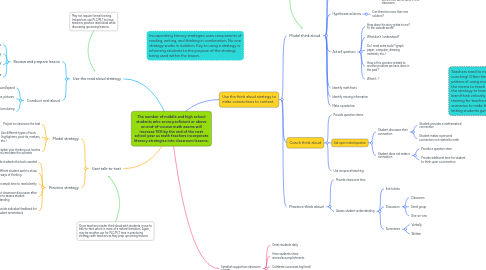
1. Use the read aloud strategy
1.1. Review and prepare lesson
1.1.1. Identify math facts
1.1.2. Identify vocabulary
1.1.3. Anticipate where students may have difficulties
1.1.4. Identify multiple approaches to a solution
1.2. Conduct real aloud
1.2.1. Vary pitch/sound/speed
1.2.2. Point out graphs, tables, pictures, etc.
1.2.3. Ask open-ended questions during reading
2. Uset talk-to-text
2.1. Model strategy
2.1.1. Project to classroom the text
2.1.2. Use different types of tools (highlighters, post-its, markers, etc.)
2.1.3. Explain your thinking out loud as you annotate the scenario
2.2. Practice strategy
2.2.1. Provide students the tools needed
2.2.2. Share differnt student work to show various ways of thinking
2.2.3. Provide ample time to read siliently
2.2.4. Conduct classroom discussion after practice to assess student understanding
2.2.5. Provide individual feedback for student annotations
3. Use the think aloud strategy to make connections to content
3.1. Model think aloud
3.1.1. Visualize/describe/draw what the scenario "appears to you"
3.1.1.1. Charts/diagrams/tables
3.1.1.2. Picture
3.1.2. Tell a story that relates to the scenario or characters, etc.
3.1.2.1. Tell a personal story and what the scenario calls to mind
3.1.2.2. Recall previous math problems or stories that we've done in the classroom
3.1.3. Hypothesize solutions
3.1.3.1. Can there be more than one solution?
3.1.4. Ask self questions
3.1.4.1. How does this story relate to me? To the outside world?
3.1.4.2. What don't I understand?
3.1.4.3. Do I need extra tools? (graph paper, computer, drawing materials, etc.)
3.1.4.4. How is this scenario related to another problem we have done in the past?
3.1.4.5. What if...?
3.1.5. Identify math facts
3.1.6. Identify missing information
3.1.7. Make a prediction
3.2. Coach think aloud
3.2.1. Provide question stems
3.2.2. Ask open ended question
3.2.2.1. Student discusses their connection
3.2.2.1.1. Student provides a mathematical connection
3.2.2.1.2. Student makes a personal connection not related to math
3.2.2.2. Student does not make a connection
3.2.2.2.1. Provide a question stem
3.2.2.2.2. Provide additional time for student to think upon a connection
3.2.3. Use reciprocal teaching
3.3. Practice think aloud
3.3.1. Provide classroom time
3.3.2. Assess student understanding
3.3.2.1. Exit tickets
3.3.2.2. Discussion
3.3.2.2.1. Classroom
3.3.2.2.2. Small group
3.3.2.2.3. One-on-one
3.3.2.3. Summarize
3.3.2.3.1. Verbally
3.3.2.3.2. Written