


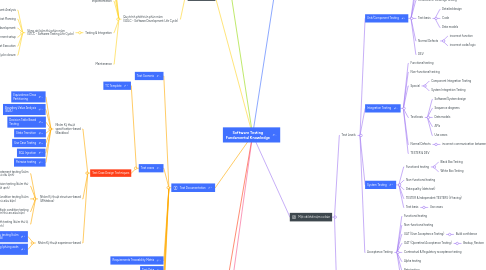
1. 7 Principles of Software Testing
1.1. Testing shows presence of defects
1.2. Exhaustive testing is not possible
1.3. Early testing
1.4. Defect clustering
1.5. Pesticide paradox
1.6. Testing is context dependent
1.7. Absence of errors fallacy
2. SDLC Models
2.1. Sequential
2.1.1. Waterfall
2.1.2. V-model
2.2. Iterative (2-4w)
2.2.1. RUP
2.2.2. Scrum
2.2.3. Kanban
2.3. Quy trình phát triển phần mềm (SDLC - Software Development Life Cycle)
2.3.1. Planning
2.3.2. Analysis
2.3.3. Design
2.3.4. Implementation
2.3.5. Testing & Integration
2.3.5.1. Vòng đời kiểm thử phần mềm (STLC - Software Testing Life Cycle)
2.3.5.1.1. Requirement Analysis
2.3.5.1.2. Test Planning
2.3.5.1.3. Test case development
2.3.5.1.4. Test Environment setup
2.3.5.1.5. Test Execution
2.3.5.1.6. Test Cycle closure
2.3.6. Maintenance
3. Test Documentation
3.1. Test Scenario
3.2. Test cases
3.2.1. TC Template
3.2.2. Test Case Design Techniques
3.2.2.1. Nhóm Kỹ thuật specification-based (Blackbox)
3.2.2.1.1. Equivalence Class Partitioning
3.2.2.1.2. Boundary Value Analysis (BVA)
3.2.2.1.3. Decision Table Based Testing
3.2.2.1.4. State Transition
3.2.2.1.5. Use Case Testing
3.2.2.1.6. SQL Injection
3.2.2.1.7. Pairwise testing
3.2.2.2. Nhóm Kỹ thuật structure-based (Whitebox)
3.2.2.2.1. Statement testing (kiểm thử câu lệnh)
3.2.2.2.2. Decision testing (kiểm thử quyết định)
3.2.2.2.3. Condition testing (kiểm thử điều kiện)
3.2.2.2.4. Multiple condition testing (kiểm thử đa điều kiện)
3.2.2.2.5. Path testing (kiểm thử lộ trình)
3.2.2.3. Nhóm Kỹ thuật experience-based
3.2.2.3.1. Exploratory testing (kiểm thử thăm dò)
3.2.2.3.2. Error guessing (phỏng đoán lỗi)
3.3. Requirements Traceability Matrix
3.4. Test Data
3.5. Test Plan
3.6. Test Environment
3.7. Defect/Bug Life Cycle
4. How to Test a Website
4.1. Functionality
4.2. Usability testing
4.3. Interface Testing
4.4. Database Testing
4.5. Compatibility testing
4.6. Performance Testing
4.7. Security testing
4.8. Crowd Testing
4.9. Examples
4.9.1. Web App
4.9.2. Banking
5. Static Testing
6. tổng quan về testing
6.1. Tại sao phải Test
6.1.1. Phân tích yêu cầu, requirements
6.1.2. Tìm lỗi
6.1.3. Đảm bảo chất lượng sản phẩm
6.1.4. Ngăn ngừa lỗi
6.1.5. Đánh giá chất lượng sản phẩm
6.1.6. Giảm chi phí cho giai đoạn sau
6.2. Vai trò và nhiệm vụ của Test
6.2.1. Phân tích yêu cầu, requirements
6.2.2. Tìm lỗi
6.2.3. Đảm bảo chất lượng sản phẩm
6.2.4. Đánh giá chất lượng sản phẩm
6.2.5. Ngăn ngừa lỗi
6.2.6. Giảm chi phí cho giai đoạn sau
6.2.7. Tham gia, đưa ý tưởng cải thiện sản phẩm
6.3. Ứng dụng và môi trường Test
6.3.1. Web
6.3.2. Mobile
6.3.3. API
7. Một vài khái niệm cơ bản
7.1. Test Levels
7.1.1. Unit/Component Testing
7.1.1.1. Functional testing
7.1.1.2. Non-functional testing
7.1.1.3. Structural or Coverage testing
7.1.1.4. Test basis
7.1.1.4.1. Detailed design
7.1.1.4.2. Code
7.1.1.4.3. Data models
7.1.1.5. Normal Defects
7.1.1.5.1. incorrect function
7.1.1.5.2. incorrect code/logic
7.1.1.6. DEV
7.1.2. Integration Testing
7.1.2.1. Functional testing
7.1.2.2. Non-functional testing
7.1.2.3. Special
7.1.2.3.1. Component Integration Testing
7.1.2.3.2. System Integration Testing
7.1.2.4. Test basis
7.1.2.4.1. Software/System design
7.1.2.4.2. Sequence diagrams
7.1.2.4.3. Data models
7.1.2.4.4. APIs
7.1.2.4.5. Use cases
7.1.2.5. Normal Defects
7.1.2.5.1. incorrect communication between components
7.1.2.6. TESTER & DEV
7.1.3. System Testing
7.1.3.1. Functional testing
7.1.3.1.1. Black Box Testing
7.1.3.1.2. White Box Testing
7.1.3.2. Non-functional testing
7.1.3.3. Data quality (data test)
7.1.3.4. TESTER & Independent TESTERS (if having)
7.1.3.5. Test basis
7.1.3.5.1. Use cases
7.1.4. Acceptance Testing
7.1.4.1. Functional testing
7.1.4.2. Non-functional testing
7.1.4.3. UAT (User Acceptance Testing)
7.1.4.3.1. Build confidence
7.1.4.4. OAT (Operatinal Acceptance Testing)
7.1.4.4.1. Backup, Restore
7.1.4.5. Contractual & Regulatory acceptance testing
7.1.4.6. Alpha testing
7.1.4.7. Beta testing
7.1.4.8. Test basis
7.1.4.8.1. Business process
7.1.4.8.2. Use cases
7.2. Test Types
7.2.1. Functional testing
7.2.1.1. Black box testing
7.2.1.2. White box testing
7.2.1.3. Smoke Testing
7.2.1.4. Sanity Testing
7.2.1.5. Unit Testing
7.2.1.6. Integration Testing
7.2.1.7. Acceptance testing
7.2.1.8. Regression Testing
7.2.2. Non-functional testing
7.2.2.1. Performance Testing
7.2.2.1.1. Load Testing
7.2.2.1.2. Volume Testing
7.2.2.1.3. Stress Testing
7.2.2.2. Security Testing
7.2.2.2.1. Penetration Testing
7.2.2.3. Compatibility Testing
7.2.2.4. Migration Testing
7.2.3. Structural or Coverage testing
7.2.3.1. White Box Testing
7.2.3.2. Test Coverage
7.2.4. Testing related to changes (~ Maintenance Testing)
7.2.4.1. Confirmation testing
7.2.4.1.1. Fix bugs or not?
7.2.4.2. Regression Testing
7.2.4.2.1. Automation Test