


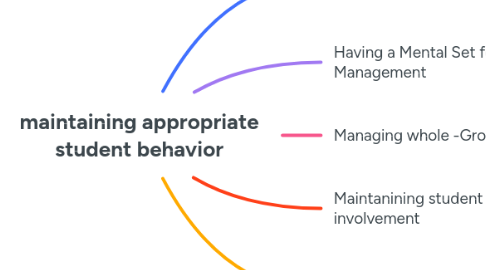
1. Buliding positive teacher-student relationships
1.1. Communicating Caring and support
1.1.1. Definition
1.1.1.1. Academic achievement and student behavior are influenced by the quality of the teacher -student relationship
1.1.2. the pillars of solid relationship with student
1.1.2.1. openness
1.1.2.2. trust
1.1.2.3. acceptance
1.1.3. example of guidelines to build positive relationship
1.1.3.1. learn about your students live
1.1.3.2. Use positive human relation skills
1.1.3.3. Enable success
1.1.3.4. Communicate basic attitudes and expectations to students and modle them in your behavior
1.1.3.5. Communicate high expectations
1.1.3.6. Give specific ,descriptive feedback
1.1.3.7. Maintain a high ratio of positive to negative statments
1.1.3.8. Be fair and consistent
1.1.3.9. Listen to students
1.1.3.10. Be sensitive to cultural and ethnic differences
1.1.3.11. show your respect and caring to students
1.1.3.12. Create opportunities for personal discussions and interaction
1.2. Relationships in Urban Settings
1.2.1. example
1.2.1.1. learn about the students community to help understand their lives and experiences
1.2.1.2. Share some information about yourself with the students
1.2.1.3. Show students you care about them individually
1.2.1.4. Be respectful of students cultures
1.3. Level of Dominance
1.3.1. level of dominance to manage classroom
1.3.1.1. High dominance
1.3.1.2. A moderate to high level of dominance
1.3.1.3. A moderate to high level of cooperation
1.3.2. express dominance by
1.3.2.1. Establish rules and procedures
1.3.2.2. Use disciplinary interventions
1.3.2.3. Exhibit assertive behavior
1.3.2.3.1. use assertive body language
1.3.2.3.2. Speak in an appropriate tone of voice
1.3.2.3.3. Persist until the appropriate behavior is displayed
1.3.2.4. Establish clear learning goals
1.4. Level of Cooperation
1.4.1. Provide flexible learning goals
1.4.2. Take a personal interest in students
1.4.2.1. Ex : Meet students at the door as they come into class and say hello to each studen
1.4.3. Use equitable and positive classroom behaviors
1.4.3.1. Ex: Make eye contact with each student in the room
1.4.4. Respond appropriately to students incorrect responses
1.4.4.1. Ex : Restate the question
2. Having a Mental Set for Management
2.1. Definition : A mental set is a teaher's heightened awareness of his or her surroundings and involves a conscious effort to control one's thought and behavior in that setting
2.2. tow ideas help teacher
2.2.1. Withitness
2.2.1.1. Monitor regularly and react immediately
2.2.1.1.1. Walk around the room
2.2.1.1.2. Periodically scan the face of the students
2.2.1.1.3. As you scan the classroom
2.2.1.1.4. Make eye contact with students
2.2.1.2. Foresee problems
2.2.2. Emotional Objectivity
2.2.2.1. Is the ability to interact with students in a businesslike matter-of-fact manner even though you might be experiencing strong emotions
2.2.2.2. Techniques can use
2.2.2.2.1. Look for reasons for the misbehavior
2.2.2.2.2. Monitor your own thoughts
3. Managing whole -Group instruction
3.1. Areas
3.1.1. Preventing misbehavior
3.1.1.1. Exhibit withitness
3.1.1.2. Use overlapping
3.1.1.3. Use desists
3.1.1.4. Avoid satiation
3.1.2. Managing movement through the lesson
3.1.2.1. To minimize misbehavior
3.1.2.1.1. Momentum
3.1.2.1.2. Smoothness
3.1.2.2. problems in maintain movement through lesson
3.1.2.2.1. Dangle
3.1.2.2.2. Flip-flop
3.1.2.2.3. Jerkiness
3.1.2.2.4. Slowdown
3.1.2.2.5. Stimulus bound
3.1.2.2.6. Thrust
3.1.2.2.7. Trunction
3.1.3. Maintaining group focus
3.1.3.1. Definition
3.1.3.1.1. Group focus occurs when a teacher makes a conscious effort to keep the attention of all students at all times ,it will reduces student misbehavior
3.1.3.2. Includes
3.1.3.2.1. Use group alerting
3.1.3.2.2. Maintain group accountability
3.1.3.2.3. Use high-particiption formats
4. Maintanining student attention and involvement
4.1. Guidelines
4.1.1. Use attention-getting strategies
4.1.1.1. Physical
4.1.1.2. Provocative
4.1.2. Arrange the classroom so that student do not have their backs to the speaker
4.1.3. Select a seating arrangement that does not discriminate against some student
4.1.4. Monitor attention during lessons and provide situational assistance as necessary
4.1.5. Keep lessons moving at a good pace
4.1.6. Vary instructional media and methods
4.1.7. Stimulate attention periodically
4.1.8. Show enthusisam
4.1.9. Use humor
4.1.10. Use questions effectively to maintain attention
4.1.11. Maintain individual accountability
4.1.12. Pay close attention when students talk and answer questions
4.1.13. Reinforce students efforts and maintion a high ratio of positive to negative verbal statments
4.1.14. Terminate lessons that have gone on too long
5. Improving classroom climate with Reinforcers
5.1. Definition
5.1.1. A reinforcer is an event or consequence that increases the strength or future probability of the behavior it follows
5.2. Types of Reinforcers
5.2.1. Recognition
5.2.2. Activities and Privileges
5.2.2.1. Example
5.2.2.1.1. Playing a game
5.2.2.1.2. Going to the library
5.2.2.1.3. Taking attendance
5.2.2.1.4. Shutting down the computer
5.2.3. Tangible Reinforcers
5.2.4. Token reinforcers
5.2.5. Using reinforcers effectively