


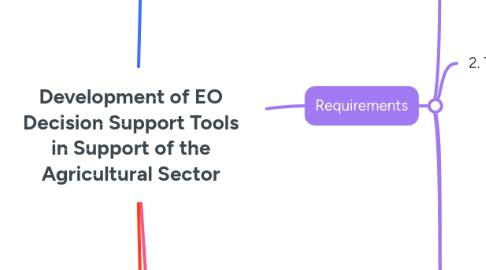
1. Target Users/ Beneficiaries
1.1. 1. Farmers
1.1.1. a. Yield estimation
1.1.2. b. Farm conditions
1.1.2.1. i. Pests and diseases
1.1.2.2. ii. soil Nutrient content
1.1.3. c. Farm inputs recommendations
1.1.4. d. Climatic conditions
1.1.5. e. Seed type for a particular crop (cultivar)
1.1.6. f. Field preparation and management methods
1.1.7. g. Mitigation measures
1.1.8. h. Access to financing
1.1.9. i. Insurance
1.1.10. j. Value chains
1.1.10.1. i. Markets
1.1.10.1.1. Demographics
1.1.10.1.2. Access
1.1.10.1.3. Functionality/ Infrastructure
1.1.10.1.4. Prices
1.1.10.2. ii. Value addition/ processing
1.1.10.3. iii. Access to quality inputs
1.1.10.4. iv. Distribution logistics
1.1.10.5. v. Post-harvest handling
1.1.11. k. Advisory services
1.1.12. l. Access to quality inputs
1.1.13. m. Mechanization
1.1.14. n. Value Addition
1.1.15. o. Product & tools development
1.1.15.1. Academia
1.2. 2. Policy makers/ Decision makers
1.2.1. a. Farm condition
1.2.1.1. Pests & Diseases
1.2.2. b. Land ownership/ cadastre
1.2.3. c. LULC
1.2.3.1. Spatial planning
1.2.4. d. Crop type mapping
1.2.5. e. Enumeration of farmer
1.2.6. f. specific crop area estimation
1.2.7. g. Farm condition
1.2.8. h. Farmers support cost estimates
1.2.9. i. Food & Nutrition security
1.2.10. j. Feed security
1.2.11. k. Disaster management
1.2.12. l. Product/ Tools development
1.2.12.1. Validation
1.3. 3. Research & Academic Institutions
1.3.1. a. High resolution geospatial data
1.3.2. b. Financing
1.3.3. c. Access to latest technologies from partners
1.3.4. d. Field collected data at a fine scale
1.3.5. e. Industrial linkages
1.3.5.1. Insights into challenges/ industry needs
1.3.6. f. Data storage & sharing infrastructure
1.3.6.1. FAIR data
1.4. 4. Geospatial technology companies and organizations
1.4.1. a. Access to data (spatial & non-spatial)
1.4.1.1. Access to very high resolution data
1.4.2. b. Access to financing
1.4.2.1. Provision of products to users
1.4.3. c. Data privacy and confidentiality issues
1.4.4. d. Field data collection
1.4.4.1. Repository for *in situ* data
1.4.4.2. SOP for data collection & management
1.4.5. e. Data sharing
1.4.5.1. Interoperability
1.4.5.2. Data exchange
1.4.6. f. Skills (GIT)
1.4.6.1. Retention
1.4.7. g. Adoption of technologies/ products
1.4.7.1. Bottom-up approach to user needs assessment
1.4.7.2. Stakeholder engagement
1.4.7.3. Emerging issues
1.5. 5. NGOs and Civil Societies (advocacy and support)
1.5.1. a. Yield prediction
1.5.2. b. Farm condition
1.5.3. c. Farmers inventory
1.5.4. d. Farm inputs
1.5.5. e. Seed type
1.5.6. f. Mitigation measures
1.6. 6. Farmer Service Providers
1.6.1. a. Crop maps
1.6.2. b. Crop suitability maps
1.6.3. c. Farm conditions
1.6.3.1. Soil condition
1.6.3.2. Weather information
1.6.4. d. Yield estimates
1.6.5. e. Mapping agrodealers
1.6.6. f. Logistics
1.6.7. g. User feedback
1.7. 7. Members of the public
1.7.1. a. Mentorship programs
2. Requirements
2.1. 1. EO data
2.1.1. a. High spatial, spectral and temporal resolution EO & Drone imagery
2.1.1.1. i. Less than 10 m
2.1.1.2. ii. Hyperspectral data
2.1.1.3. iii. 5 - 10 days
2.1.2. b. Spectral reflectance libraries
2.1.3. c. Weather & climate data (continuous and up-to-date)
2.1.4. d. Soils data
2.1.5. e. Data quality standards & QA, sharing frameworks
2.1.6. f. Analysis Ready Data (ARD) EO data
2.2. 2. Trained personnel
2.2.1. a. EO data processing (atmospheric & radiometric correction) expertise
2.2.2. b. Agronomists
2.2.3. c. Agrofinance
2.2.4. d. Agricultural Economists
2.2.5. e. Soil scientists
2.2.6. f. Data governance/ policy & regulation
2.2.7. g. Data security expertise
2.2.7.1. i. Climate scientists
2.2.8. h. Database management expertise
2.2.9. j. Data scientists
2.2.10. k. Geospatial scientists
2.3. 3. Laboratory facilities
2.3.1. a. Computing (Hardware, software, networks, and cloud)
2.3.2. b. Soil testing
2.3.3. c. Data handling hubs/ repositories
2.3.4. d. Field Spectroradiometry
2.4. 4. Ground reference data
2.4.1. a. Farmer profiling
2.4.1.1. Acreage, farm management practices (tillage, inputs), yields, value chains
2.4.1.2. ii. Mobile applications (Apps, SMS, USSD) linking farmers, Agricultural Extension Officers & Data Analysts
2.4.2. b. Agronomy field trials data
2.4.3. c. *In situ* data for validation
2.4.3.1. i. Weather data
2.4.3.2. ii. Soil sampling data
3. Key Benefits
3.1. Access to quality farm conditions data
3.2. Collaboration among stakeholders
3.3. Minimises duplication of efforts
3.4. Improved yield
3.5. Targeted support and financing
3.6. Early warning and mitigation
3.7. Yield, crops and farmers inventories
3.8. Address farmers needs
3.9. Support extension services
3.10. Support policy and regulation formulation
4. Potential EO Tools & Products
4.1. DSS supporting
4.1.1. 1. Crop type mapping
4.1.1.1. a. Crop type maps @10m resolution based on S-2 data (GEOGLAM)
4.1.1.2. b. Crop mapping geostatistics @50cm- field finder tool (field finder tool) (LocateIT)
4.1.1.3. c. Regional Food Balance Sheet platform (RCMRD)
4.1.2. 2. Crop area
4.1.2.1. a. Crop area estimate maps @10 m resolution based on S-2 data, employing linear regression models (GEOGLAM)
4.1.2.2. b. Crop area estimates @50cm resolution (GEOGLAM)
4.1.2.3. c. Crop land estimates from drone data (Spatial Collective)
4.1.2.4. d. Crop land extent map, GeoMAD (DEA)
4.1.2.5. e. Continental agriculture map using S2 data (RCMRD)
4.1.2.6. f. Regional Food Balance Sheet platform (RCMRD)
4.1.3. 3. Farm management/ advice
4.1.3.1. a. Agwise decision support framework: soil fertility mngt; planting dates determination; type and variety of crop to plant (CGIAR)
4.1.3.2. b. Fertilizer need estimates @50cm resolution (LocateIT)
4.1.3.3. c. Creating farmers database (cadastre DB) (LocateIT)
4.1.3.4. d. Advise on fertiliser input & farming practises (LocateIT)
4.1.3.5. e. Capacity building
4.1.3.6. f. Farm management solutions (Antugrow)
4.1.3.7. g. Digital climate advisory: agronomy+weather data via sms notification (TomorrowNow)
4.1.3.8. h. Crop monitor reports for early warning & food security (MOA)
4.1.3.9. i. Food production report (MOA)
4.1.3.10. j. Fractional cover, NDVI, Water observation, coastline data (DEA)
4.1.3.11. k. Weather images, satellite derived weather data, weather & climate impacts data, downscaled forecasts, advisories & assessments (KMD)
4.1.3.12. l. Africa data watch: monitoring & early warning tool- fertiiser data (Africa fertiliser under IFDC)
4.1.3.13. m. Kenya fertiliser dashboard (Africa fertiliser under IFDC)
4.1.3.14. n. Earth observation data cube (KALRO)
4.1.3.15. o. Suitability maps website (KALRO)
4.1.3.16. p. Crop/livestock/pasture selection app (KALRO)
4.1.3.17. q. Kenya Agricultural Observatory Platform KAOP (KALRO)
4.1.3.18. r. Soil Health Framework: ongoing (KALRO)
4.1.3.19. s. AI tools: future works (KALRO)
4.1.3.20. t. Soils4Africa: Soils Info System (RCMRD)
4.1.3.21. u. Risk management system for pests and diseases (RCMRD)
4.1.3.22. w. Regional Food Balance Sheet platform (RCMRD)
4.1.3.23. x. County maize yield production maps using S2 and Planet data (DRSRS)
4.1.3.24. y. Group on Earth Observation (GEO)
4.1.4. 4. Policy development/ amendment; Regulation development
4.1.4.1. Data sharing
4.1.5. 5. Climate Change mitigation
4.1.5.1. a. Adaptation for Smallholder Agricultural Programme (ASAP)
4.1.5.2. b. Early warning systems (LocateIT)
4.1.5.3. c. Land degradation maps to support jazamiti app (RCMRD)
4.1.5.4. d. Invasive species maps (RCMRD)
4.1.5.5. e. Biodiversity mapping (RCMRD)
4.1.6. 6. Land Use Land Cover (LULC)