


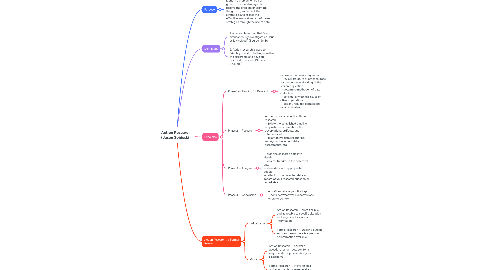
1. Purpose
1.1. Action research allows you to identify a problem or area of growth, discuss strategies to resolve the problem or promote the growth, implement the strategies, and assess the effectiveness and impact of those strategies through the use of data.
2. Definitions
2.1. 1. A research method that "aims to simultaneously investigate an issue as it is solved." (Source: Scribbr)
2.2. 2. Action research is used to "identify specific challenges within the classroom and develop practical solutions." (Source: SIUE.edu)
3. Principles
3.1. Phase 1 -- Planning for Research
3.1.1. -- design the research question -- review literature or other sources for deeper understanding of the research question -- determine method(s) of data collection -- consider any ethical issues or other implications -- get any required permissions -- set a timeline
3.2. Phase 2 -- Research
3.2.1. -- conduct data collection through research -- follow the established timeline -- qualitative observations like observations, artifacts, and interviews, etc. -- quantitative data like rubrics, surveys, achievement data, assessments, etc.
3.3. Phase 3 -- Analysis
3.3.1. -- organize collected data into visuals -- look for trend(s) in the collected data -- share data with appropriate people -- reflect on the collected data and impact of your research question or tested idea
3.4. Phase 4 -- Conclusion
3.4.1. -- draft and share your findings -- consider what was successful and where to go next
4. Action Research vs. Formal Research
4.1. Advantages
4.1.1. Action Research -- More flexibile and adaptable to specific situation and very direct source of information.
4.1.2. Formal Research -- Utilizing outside sources means there is a plethora of information available.
4.2. Goals
4.2.1. Action Research -- Answer a question, test an idea, etc. for a very specific population (i.e. your classroom).
4.2.2. Formal Research -- Prove an idea or theory that is more general and can be used by many.