
Bennis and Nanus Transformational Leadership Theory

Explore the intricacies of effective leadership styles through our comprehensive mindmap titled "Blake and Mouton's Leadership Grid". This informative mindmap dives deep into a leadership model developed by luminaries Robert Blake and Jane Mouton. Discover the specific aims of their grid, which aims to identify and classify leadership styles based on two key components: 'Concern for People' and 'Concern for Production'. The mindmap further explores the various shades of these parameters, incl...

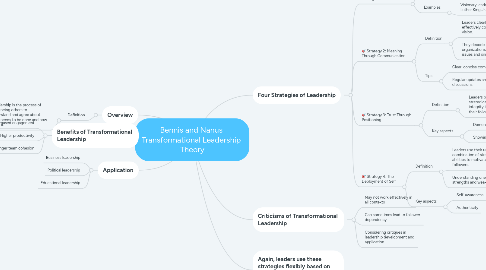
1. Overview
1.1. Definition
1.1.1. "Leadership is the process of influencing others to understand and agree about what needs to be done and how to do it."
2. Benefits of Transformational Leadership
2.1. Increased engagement
2.2. Higher productivity
2.3. Stronger team cohesion
3. Application
3.1. Business leadership
3.2. Political leadership
3.3. Educational leadership
4. Four Strategies of Leadership
4.1. 🎯 Strategy 1: Attention Through Vision
4.1.1. Definition
4.1.1.1. Leaders articulate an appealing vision of the future to draw follower's attention.
4.1.2. Examples
4.1.2.1. Visionary leaders like Martin Luther King Jr., Steve Jobs
4.2. 🎯 Strategy 2: Meaning Through Communication
4.2.1. Definition
4.2.1.1. Leaders clearly and effectively communicate the vision.
4.2.1.2. They decode the organization’s complex issues and simplify ambiguity.
4.2.2. Tips
4.2.2.1. Clear, concise communication
4.2.2.2. Regular updates and discussions
4.3. 🎯 Strategy 3: Trust Through Positioning
4.3.1. Definition
4.3.1.1. Leaders position themselves strategically and act with integrity to earn the trust of their followers.
4.3.2. Key aspects
4.3.2.1. Demonstrating competence
4.3.2.2. Showing integrity
4.4. 🎯 Strategy 4: The Deployment of Self
4.4.1. Definition
4.4.1.1. Leaders use their unique combination of strengths and abilities to motivate followers.
4.4.1.2. Understanding one’s strengths and weaknesses.
4.4.2. Key aspects
4.4.2.1. Self-awareness
4.4.2.2. Authenticity