
Burns Transformational Leadership Theory

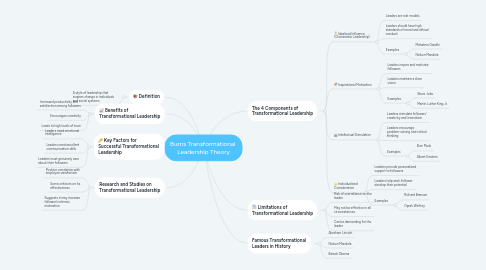
Explore the intricacies of Burns Transformational Leadership Theory with our comprehensive mindmap, drawing attention to every key aspect. Starting with the definition and attributes of transformational and transactional leadership, the theory emphasizes on four fundamental elements of transformational leadership - individualized consideration, intellectual stimulation, inspirational motivation, and idealized influence. Delve into the positive and negative contingencies under impact and outco...

1. 📚 Definition
1.1. A style of leadership that inspires change in individuals and social systems.
2. 📈 Benefits of Transformational Leadership
2.1. Increased productivity and satisfaction among followers
2.2. Encourages creativity
2.3. Leads to high levels of trust
3. 🔑 Key Factors for Successful Transformational Leadership
3.1. Leaders need emotional intelligence
3.2. Leaders need excellent communication skills
3.3. Leaders must genuinely care about their followers
4. Research and Studies on Transformational Leadership
4.1. Positive correlation with employee satisfaction
4.2. Some criticism on its effectiveness
4.3. Suggests it may increase follower’s intrinsic motivation
5. The 4 Components of Transformational Leadership
5.1. 🏅 Idealized Influence (Charismatic Leadership)
5.1.1. Leaders are role models
5.1.2. Leaders should have high standards of moral and ethical conduct
5.1.3. Examples
5.1.3.1. Mahatma Gandhi
5.1.3.2. Nelson Mandela
5.2. 🚀 Inspirational Motivation
5.2.1. Leaders inspire and motivate followers
5.2.2. Leaders maintain a clear vision
5.2.3. Examples
5.2.3.1. Steve Jobs
5.2.3.2. Martin Luther King Jr.
5.3. 👥 Intellectual Stimulation
5.3.1. Leaders stimulate followers' creativity and innovation
5.3.2. Leaders encourage problem-solving and critical thinking
5.3.3. Examples
5.3.3.1. Elon Musk
5.3.3.2. Albert Einstein
5.4. 🤝 Individualized Consideration
5.4.1. Leaders provide personalized support to followers
5.4.2. Leaders help each follower develop their potential
5.4.3. Examples
5.4.3.1. Richard Branson
5.4.3.2. Oprah Winfrey