

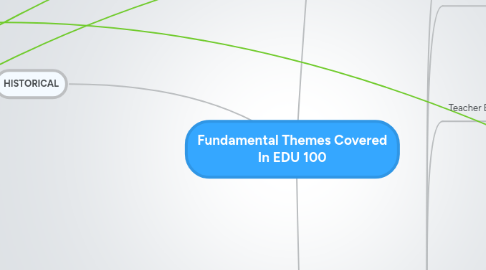
1. HISTORICAL
1.1. WWII
1.1.1. Institutions of modern, mass public ed. expanded and redefined (Kachur, Harrison)
1.1.2. "Welfare State"
1.1.2.1. Politics of education and inclusion focused primarily on policies related to language, multiculturalism, & feminism. (Kachur, Harrison)
1.1.2.2. Unravels - 1970s
1.1.2.2.1. corporate taxes decline
1.1.2.2.2. middle class taxes rose
1.1.2.2.3. unemployment rose
1.1.3. Increased social mobility
1.2. Public ed in post-war era based upon capitalist economy. Politically and socially liberal premises (Kachur, Harrison)
1.3. Rise in globalization
1.3.1. world-wide economic, political, technological changes
1.3.2. Ideological and structural changes (cultural interaction, rise of "global village"(Kachur, Harrison)
1.3.3. Neg. consequences (rise of religious fundamentalism, ethnic nationalism) (Kachur, Harrison)
1.3.4. Reducation, shifting, or transformation of state powers (Kachur, Harrison)
1.3.5. Widening of wealth gap
1.3.6. Increased importance of education (competition, quality, access)
1.3.6.1. Assumption that competitive advantage in global econ. goes to country with best-educated workforce (Kachur, Harrison)
1.4. Education in AB ideologically driven (Kachur, Harrison)
1.4.1. gov't has centralized authority and decreased equality of student opportunity while opening market niches for private entrepreneurs (Kachur, Harrison)
1.4.2. Neo-liberal basis of ideas
1.5. Progressive Conservatives re-elected in AB - 1993 (Kachur, Harrison)
1.5.1. REFORM
1.5.1.1. decreased living standards
1.5.1.2. slow growth
1.5.1.3. increased unemployment
1.5.2. Economic Crises
1.5.2.1. education scapegoated
1.5.2.1.1. Argue for increased parental choice
1.5.2.1.2. Decried teachers unions, educational bureaucrats, university theoreticians (Kachur, Harrison)
1.5.2.1.3. Poor economic conditions attributed to poor educational performance, high costs
1.5.3. New Right
1.5.3.1. neo-liberalism + political & social conservativism
1.5.3.1.1. Focus on education
1.5.3.1.2. understanding of human capital development
1.5.3.1.3. coercive and manipulative change implementation (Kachur, Harrison)
1.5.3.1.4. Increase of inequality
1.5.4. Debt crises
2. SOCIOLOGICAL
2.1. Family as primary socializer
2.2. School as Secondary Socializer
2.2.1. extent of socialization in school depends on family background (Barakett)
2.2.2. Teachers and peers become significant others
2.2.2.1. teachers may affect student in way comparable to parent or close relative (Barakett)
2.2.3. Problems with tracking and typifications
2.2.3.1. Grades and judgements become identity of student
2.2.4. Political socialization
2.2.4.1. role that schools play in inculcating the values and norms that support prevailing structures of society (Barakett)
2.2.5. Moral socialization
2.2.5.1. schools instill idealized version of society's values
2.2.6. *HIDDEN CURRICULUM
2.2.7. Agent of moral and political socialization
2.3. Influence of peer groups and popular culture increases
2.3.1. how does this affect pedagogical practice?
2.4. Schools reproduce inequalities.
2.4.1. Children from disparate homes enter formal schooling at a disadvantage
2.4.1.1. cannot fully compensate for wider social inequities beyond their control (Davies)
2.4.2. Children from privileged backgrounds maintain privileges
2.4.3. Persistence of socioeconomic gradients from kindergarten to age 15 (Davies)
2.5. More gender parity
2.5.1. However, teaching profession is becoming "refeminized"" (Davies)
2.6. Problem of "vertical mosaic" (Davies)
2.6.1. race and ethnicity still seem to affect students' success and futures
2.6.2. "cultural mismatches"between families and educators
2.6.2.1. * Jonathan from American teacher touches on this - - he emphasizes importance of students having a teacher who they can relate to and who understands their cultural and familial background
2.7. Money still required to be academically successful (Davies)
2.7.1. ex: paying for tutors, buying school supplies, paying tuition
2.7.1.1. Lecture from Dr. Kachur: disadvantaged continue to be disadvantaged.
2.8. Patterns of attainment becoming more predictable (Davies)
2.8.1. for example: Native and African Canadian children suffer, while Asian Canadian children do quite well.
3. PHILOSOPHICAL
3.1. Academic Success prized (Davies)
3.1.1. Parents actively intervene to systematically improve offspring's life chances
3.1.1.1. reproduces status and advantage across generations through personal achievment
3.2. Children from disparate homes are disadvantaged when starting school.
3.3. Teacher Education (Barakett)
3.3.1. important to discuss when addressing educational and social inequality generated through hidden curriculum
3.3.2. Influenced by dominant ideological discourses
3.3.3. critical and feminist theory and pedagogy can contribute to teacher education and to teaching methods courses
3.3.4. affects teacher's practices, in turn affecting students school performance
3.4. Theories
3.4.1. Funtionalist
3.4.1.1. Individual reacts and responds to people and situations according to sets of structured situational responses (Barakett)
3.4.1.1.1. teacher as agent of adult society
3.4.1.2. Social reality viewed as objective, external to, independent of individual (Barakett)
3.4.2. Freud's Psychoanalytic Theory
3.4.2.1. Biological factors explain
3.4.2.1.1. Id/ego/superego negotiate actions.
3.4.3. Piaget's Cognitive perspective
3.4.3.1. Student as active learner, negotiating right and wrong
3.4.3.1.1. moral realism
3.4.3.1.2. moral autonomy
3.4.3.1.3. * Michael Phair's lecture reminded me of this: as teachers, we can mediate what a student understands to be right and wrong. encourage inclusivity, denounce ignorince and prejudice.
3.4.4. Social learning theory
3.4.4.1. focuses on environmental factors surrounding child (Barakett)
3.4.4.1.1. reinforcement shapes behaviour to conform with expectations of agents such as teachers and parents.
3.4.4.1.2. observe and imitate behaviour, beliefs, and norms held by those closest to them
3.4.5. Mead's theory
3.4.5.1. SELF
3.4.5.1.1. I
3.4.5.1.2. ME
3.4.5.2. Becomes object to oneself by taking into account the attitudes of significant others
3.4.5.3. not merely reacting; active agent interpreting selecting, then acting (Barakett)
3.4.5.3.1. role-taking
3.4.5.3.2. role playing
3.4.5.4. eventually takes role of generalized other
3.4.5.5. NURTURE (vs. nature)
3.4.6. Schutz
3.4.6.1. Intersubjectivity
3.4.6.1.1. how individuals act in the context of an intersubjective reality
3.4.6.1.2. knowledge we have accumulated through our experiences
3.4.6.2. self, language, and interpretations of objects and situations emerge through typification process (copying of social types), rather than through the internalization of Meads generalizsed other