


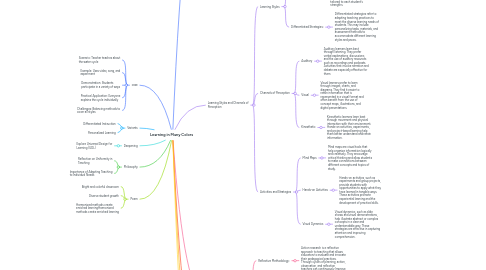
1. case
1.1. Scenario: Teacher teaches about the water cycle
1.2. Example: Uses video, song, and experiment
1.3. Demonstration: Students participate in a variety of ways
1.4. Practical Application: Everyone explains the cycle individually
1.5. Challenges: Balancing methods to cover all styles
2. Variants
2.1. Differentiated Instruction
2.2. Personalized Learning
3. Deepening
3.1. Explore Universal Design for Learning (UDL)
4. Philosophy
4.1. Reflection on Uniformity in Teaching
4.2. Importance of Adapting Teaching to Individual Needs
5. Poem
5.1. Bright and colorful classroom
5.2. Diverse student growth
5.3. Harmonized methods create enriched learningHarmonized methods create enriched learning
6. Multiple Forms of Representation
6.1. Universal Design for Learning (UDL)
6.1.1. Inclusion and Equity in the Classroom
6.1.1.1. Implementing UDL in the classroom means designing learning experiences that are accessible to all students, regardless of their abilities or backgrounds. This approach promotes inclusion and ensures that all students have equal opportunities to learn, eliminating barriers to learning.
6.1.2. Diverse Forms of Representation
6.1.2.1. UDL encourages the use of multiple forms of representation to present information. This includes the use of text, images, graphics, and audiovisual content to ensure that students can access the material in a way that best suits their learning needs.
6.2. Tools and Resources
6.2.1. Graphics:
6.2.1.1. Graphics are visual tools that help students process and understand information more effectively. They can include diagrams, charts, infographics, and other visual elements that simplify complex concepts and improve information retention.
6.2.2. Text:
6.2.2.1. Texts, in their various forms, are fundamental to learning. They can be adapted to include different levels of difficulty and writing styles, allowing students to access content in a way that is understandable and relevant to them.
6.2.3. Audiovisual:
6.2.3.1. Audiovisual resources, such as videos and animated presentations, enrich the learning process by offering a richer sensory experience. These types of resources can better capture students' attention and make learning more dynamic.
6.2.4. Digital Tools:
6.2.4.1. Digital tools, such as interactive applications and online learning platforms, offer innovative ways of presenting content and allow for more interactive and personalized learning. These tools can be adapted to individual students' needs.
7. Learning Styles and Channels of Perception
7.1. Learning Styles
7.1.1. Multiple Intelligences:
7.1.1.1. The theory of multiple intelligences maintains that students possess different types of intelligence, such as linguistic, logical-mathematical, spatial, musical, interpersonal, intrapersonal, naturalistic, and kinesthetic. Recognizing these differences allows teaching to be tailored to each student's strengths.
7.1.2. Differentiated Strategies:
7.1.2.1. Differentiated strategies refer to adapting teaching practices to meet the diverse learning needs of students. This may include personalizing tasks, materials, and assessment methods to accommodate different learning styles and paces.
7.2. Channels of Perception
7.2.1. Auditory
7.2.1.1. Auditory learners learn best through listening. They prefer verbal explanations, discussions, and the use of auditory resources such as recordings and podcasts. Activities that involve narration and debate are especially effective for them
7.2.2. Visual
7.2.2.1. Visual learners prefer to learn through images, charts, and diagrams. They find it easier to retain information that is represented in a visual format and often benefit from the use of concept maps, illustrations, and digital presentations.
7.2.3. Kinesthetic
7.2.3.1. Kinesthetic learners learn best through movement and physical interaction with their environment. Hands-on activities, experiments, and project-based learning help them better understand and retain information.
7.3. Activities and Strategies
7.3.1. Mind Maps
7.3.1.1. Mind maps are visual tools that help organize information logically and creatively. They encourage critical thinking and allow students to make connections between different concepts and topics of study.
7.3.2. Hands-on Activities
7.3.2.1. Hands-on activities, such as experiments and group projects, provide students with opportunities to apply what they have learned in tangible ways. These activities promote experiential learning and the development of practical skills.
7.3.3. Visual Dynamics
7.3.3.1. Visual dynamics, such as slide shows and visual demonstrations, help illustrate abstract or complex concepts in a clear and understandable way. These strategies are effective in capturing attention and improving comprehension.
8. Action Research: Transforming Educational Practice
8.1. Reflective Methodology:
8.1.1. Action research is a reflective approach to teaching that allows educators to evaluate and innovate their pedagogical practices. Through cycles of planning, action, observation, and reflection, teachers can continuously improve their teaching practices.
8.2. Improving Educational Practices:
8.2.1. Through action research, teachers critically analyze their teaching and implement evidence-based changes to improve learning effectiveness. This continuous improvement process helps educators adapt to the changing needs of their students.
8.3. Critical Analysis of Teaching:
8.3.1. Critical analysis of teaching involves examining pedagogical practices from different perspectives to identify areas for improvement. This analysis may include collecting data on student achievement, student feedback, and teacher self-assessment to inform future educational decisions.
9. Definition
9.1. Educational unit focused on learning diversity
9.2. Seeks to adapt educational strategies to the needs of each student
9.3. Influences: Theories of multiple intelligences and Universal Design for Learning (UDL)
10. Principle
10.1. Non-uniform learning
10.2. Creating multiple accesses to knowledge
10.3. Importance of inclusion, diversity, and adaptability
11. characteristics of learning
11.1. Inclusivity
11.1.1. Simple Explanation:
11.1.1.1. Equal participation of all
11.1.2. Academic Definition:
11.1.2.1. Equal educational opportunities for all students.
11.2. Diversity of methods
11.2.1. Simple Explanation:
11.2.1.1. Multiple teaching approaches
11.2.2. Academic Definition:
11.2.2.1. Multiple teaching approaches Various pedagogical strategies that adapt to different learning styles.
11.3. Adaptability
11.3.1. Simple Explanation:
11.3.1.1. Modification of techniques according to needs
11.3.2. Academic Definition:
11.3.2.1. Personalization of education to optimize learning based on individual student characteristics.