


1. Violating
1.1. Flouting
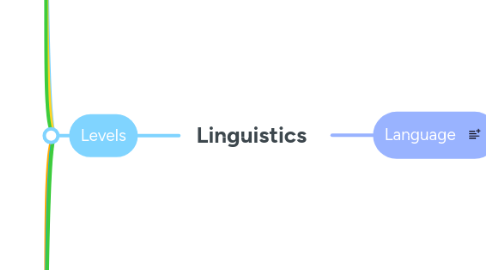
2. Language
2.1. Communication
2.1.1. Verbal
2.1.1.1. Speech
2.1.1.2. Writing
2.1.1.3. Signed language
2.1.2. Rule - governed system
2.1.3. Non-verbal
2.1.3.1. Kinesics
2.1.3.2. Proxemics
2.1.3.3. Oculesics
2.2. Characteristics of language
2.2.1. Arbitrariness
2.2.2. Discretness
2.2.3. Duality
2.2.4. Recursion
2.2.5. Description
2.3. Principles
2.4. Multidimensional
2.4.1. Psycholinguistics
2.4.1.1. Perceptive
2.4.1.2. Functions
2.4.2. Applied linguistics
2.4.3. Sociolinguistics
2.4.3.1. Variation Systems
2.4.3.2. Variation
2.4.3.3. Incorporation
2.4.4. Social factors
2.5. Descriptive
2.5.1. Prescriptive
2.6. Prescription
3. Levels
3.1. Pragmatics
3.1.1. Context
3.1.2. Maxims
3.1.2.1. Quantity
3.1.2.2. Quality
3.1.2.3. Relation
3.1.2.4. Manner
3.2. Semantics
3.2.1. Meaning
3.2.1.1. Denotation
3.2.1.2. Reference
3.2.1.3. Connotation
3.2.2. Field
3.2.3. Polysemy
3.2.4. Synonymy
3.2.5. Antonymy
3.2.6. Homonymy
3.2.7. Hyponymy
3.2.8. Ambiguity
3.2.9. Semantic shift
3.2.10. Idioms
3.3. Syntax
3.3.1. Sentences
3.3.1.1. Subject
3.3.1.2. Predicate
3.3.1.3. Argument
3.3.1.4. Adjunct
3.3.1.5. Constituency
3.3.2. Government
3.3.2.1. Agreement
3.3.3. Simple sentences
3.3.3.1. Complex sentences
3.4. Morphology
3.4.1. Structure/form
3.4.1.1. Content/lexical
3.4.2. Words
3.4.2.1. Content
3.4.2.1.1. Noun
3.4.2.1.2. Verbs
3.4.2.1.3. Adjectives
3.4.2.1.4. Adverbs
3.4.2.2. Structure
3.4.2.2.1. Pronouns
3.4.2.2.2. Determiners
3.4.2.2.3. Prepositions
3.4.2.2.4. Conjunctions
3.4.3. Morphemes
3.4.3.1. Compounding
3.4.3.1.1. Compound sentences
3.4.4. Types
3.4.4.1. Isolation
3.4.4.2. Analytic
3.4.4.3. Synthetic
3.4.4.4. Inflecting
3.4.4.5. Agglutinating
3.4.4.6. Fusion
3.4.4.7. Transfixation
3.5. Phonology
3.5.1. phonemes
3.5.2. Accent
3.6. Phonetics
3.6.1. Sounds
3.6.2. Phones
3.6.3. Auditory
3.6.4. Acoustics
3.6.5. Articulatory
3.6.5.1. Suprasegmental features
3.6.5.1.1. Stress
3.6.5.1.2. Tone
3.6.5.1.3. Syllables
3.6.5.1.4. Intonation